Klassifizierung / Names
Namen | Synonyme | Catalog of Fishes(Gattung, Arten) | ITIS | CoL | WoRMS | Cloffa
>
Ophidiiformes (Cusk eels) >
Bythitidae (Livebearing brotulas)
Etymology: Parabrotula: Greek, para = the side of + Latin, brotula, -ae = little, bud, shoot (Ref. 45335).
Umwelt: Milieu / Klimazone / Tiefenbereich / Verbreitungsgebiet
Ökologie
seewasser bathypelagisch; tiefenbereich 0 - 3000 m (Ref. 35509). Deep-water
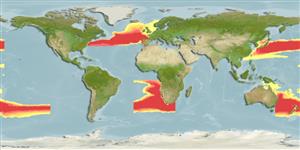
Northeast Atlantic: most of the known specimens from the area (Ref. 36126). Eastern Atlantic: Gulf of Guinea, one specimen 0°42'S, 7°E (Ref. 10800). Southeast Atlantic: off East London, South Africa. Western Pacific: Japan and Australia (Ref. 11228).
Größe / Gewicht / Alter
Geschlechtsreife: Lm ? range ? - ? cm
Max length : 5.4 cm SL Männchen/unbestimmt; (Ref. 35509)
Kurzbeschreibung
Bestimmungsschlüssel | Morphologie | Morphometrie
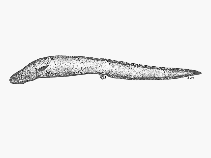
Rückenflossenstacheln (insgesamt) : 0; Rückenflossenweichstrahlen (insgesamt) : 37 - 41; Afterflossenstacheln: 0; Afterflossenweichstrahlen: 34 - 38. Body long, naked and compressed. Skin loose, thin but not gelatinous. Snout pointed. Gill opening large. Head and body uniformly dark brown in alcohol (Ref. 35852).
Found on the continental slope (Ref. 75154). Viviparous (Ref. 10800). Minimum depth from Ref. 58018.
Lebenszyklus und Paarungsverhalten
Geschlechtsreife | Fortpflanzung | Ablaichen | Eier | Fruchtbarkeit | Larven
Anderson, M.E., 1986. Parabrotulidae. p. 343. In M.M. Smith and P.C. Heemstra (eds.) Smiths' sea fishes. Springer-Verlag, Berlin. (Ref. 6608)
IUCN Rote Liste Status (Ref. 130435: Version 2025-2 (Global))
Bedrohung für Menschen
Harmless
Nutzung durch Menschen
Fischereien: bycatch
Tools
Zusatzinformationen
Download XML
Internet Quellen
Schätzungen auf der Grundlage von Modellen
Bevorzugte Temperatur (Ref.
123201): 3.7 - 10.6, mean 6 °C (based on 497 cells).
Phylogenetischer Diversitätsindex (Ref.
82804): PD
50 = 0.7500 [Uniqueness, from 0.5 = low to 2.0 = high].
Bayesian length-weight: a=0.00102 (0.00046 - 0.00225), b=3.06 (2.88 - 3.24), in cm total length, based on all LWR estimates for this body shape (Ref.
93245).
Trophische Ebene (Ref.
69278): 3.2 ±0.5 se; based on size and trophs of closest relatives
Widerstandsfähigkeit (Ref.
120179): niedrig, Verdopplung der Population dauert 4,5 - 14 Jahre. (Assuming Fec<100).
Anfälligkeit der Fischerei (Ref.
59153): Low vulnerability (10 of 100).
🛈