>
Lophiiformes (Anglerfishes) >
Himantolophidae (Footballfishes)
Etymology: Himantolophus: Greek, himas or himantos = leather strap, thong or leash (referring to the thick leathery illicium) + Greek, lopho or lophio = crest or tuft (referring to the baited illicium projecting from the head) (Ref. 86949).
Milieu: milieu / Klimaatzone / Diepte / verspreidingsgebied
Ecologie
marien bathypelagisch; diepte 330 - 1950 m (Ref. 86949). Deep-water
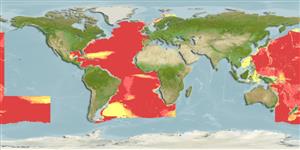
Atlantic Ocean.
Grootte / Gewicht / Leeftijd
Maturiteit: Lm ? range ? - ? cm
Max length : 19.0 cm SL mannelijk / geslacht onbekend; (Ref. 4492)
Korte beschrijving
Determinatiesleutels | Morfologie | Morfometrie
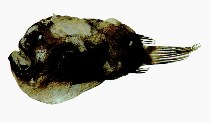
Dorsale stekels (totaal) : 0; Dorsale zachte stralen (totaal) : 5; Anale stekels: 0; Anale zachte stralen: 4. Illicium short, its base above eyes; rays of pectoral and unpaired fins black; white spot on the dorsal and ventral margins of caudal fin base respectively; two pairs of swellings in the distal end of esca, the anterior pair only half as long as the posterior one (Ref. 13608). Distinguishing characteristics of metamorphosed female: length of illicium 36-54% SL in specimens greater than 3 cm; deeply cleft distal escal appendage, undivided part 1.0-9.4% SL; each primary branch of distal escal appendage simple, darkly pigmented except on distal tip, total length 8-13% SL in specimens 3.4-6.6 cm, 25-74% SL in specimens 7.5-19 cm; length of posterior escal appendage 8.5-21% SL in specimens 3-19 cm, faint pigmentation or absent; illicial stem with posterolateral appendages 2-9, simple or branched at tip, longest 7-23% SL in specimens greater than 3 cm; absence of dermal spinules on escal bulb and appendages (Ref. 86949).
Body shape (shape guide): short and / or deep.
Levenscyclus en paargedrag
Maturiteit | Voortplanting | Paaien | Eieren | Fecunditeit | Larven
Bertelsen, E., 1990. Himantolophidae. p. 494-495. In J.C. Quero, J.C. Hureau, C. Karrer, A. Post and L. Saldanha (eds.) Check-list of the fishes of the eastern tropical Atlantic (CLOFETA). JNICT, Lisbon; SEI, Paris; and UNESCO, Paris. Vol. 1. (Ref. 4492)
Status op de Rode Lijst van het IUCN (Ref. 130435: Version 2025-2 (Global))
Gevaar voor de mens
Harmless
Gebruik door de mens
Tools
Speciale rapporten
Download XML
Internetbronnen
Schattingen op basis van modellen
Gewenste temperatuur (Ref.
123201): 4.5 - 10.1, mean 6.5 °C (based on 689 cells).
Fylogenetische diversiteitsindex (Ref.
82804): PD
50 = 0.5000 [Uniqueness, from 0.5 = low to 2.0 = high].
Bayesian length-weight: a=0.01995 (0.00906 - 0.04395), b=3.01 (2.83 - 3.19), in cm total length, based on all LWR estimates for this body shape (Ref.
93245).
Trofisch niveau (Ref.
69278): 4.2 ±0.73 se; based on food items.
Kwetsbaarheid van de visserij (Ref.
59153): Low vulnerability (13 of 100).
🛈