>
Kurtiformes (Nurseryfishes, cardinalfishes.) >
Apogonidae (Cardinalfishes) > Apogoninae
Etymology: Apogon: Greek, a = without + Greek pogon = chin, beard (Ref. 45335).
More on author: Linnaeus.
Entorno: milieu / zona climática / rango de profundidad / gama de distribución
Ecología
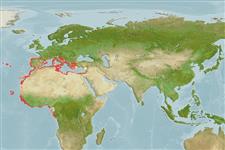
marino asociado a arrecife; no migratorio; rango de profundidad 10 - 200 m (Ref. 4738). Subtropical; 45°N - 5°S, 32°W - 36°E
Eastern Atlantic and Mediterranean Sea: Portugal to Morocco and the Azores. Elsewhere, southward to Gulf of Guinea.
Tamaño / Peso / Edad
Madurez: Lm ? range ? - 5.5 cm
Max length : 15.0 cm SL macho / no sexado; (Ref. 4738); edad máxima reportada: 5 años (Ref. 93355)
Descripción breve
Claves de identificación | Morfología | Morfometría
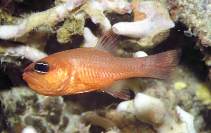
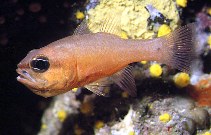
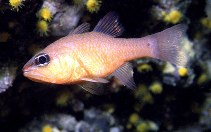
Espinas dorsales (total) : 7; Radios blandos dorsales (total) : 9 - 10; Espinas anales: 2; Radios blandos anales: 8 - 9. Eye very large, much greater than snout. Pectoral fin long, reaching at least origin of anal fin. Preopercular edge only slightly serrated, preopercular ridge smooth. Body and fins red or pink, back and upper surface of head dusky. Two or three dark spots, sometimes joined, along base of caudal fin.
Body shape (shape guide): fusiform / normal; Cross section: compressed.
Occasionally forms schools; sometimes solitary. Inhabits muddy or rocky bottoms and caves (Ref. 4738). A sciaphilous species thriving in a number of shady/dark habitats and frequents marine caves, where it forms large schools (Ref. 118281). Feeds on small invertebrates and fishes (Ref. 4738). Observed to feed in the water column and just over the bottom, always at night; 93.4% of observed events occurring outside the caves, usually on rocky bottoms and Posidonia oceanica meadows, and to a lesser extent on pebbles (Ref. 118281). Oral brooding by males (Ref. 4738).
Males incubate eggs in buccal cavity (Ref. 205, 4738, 74407). Embryos do not feed externally in the buccal cavity. Distinct pairing during courtship and spawning (Ref. 205). Internal fertilization and paternal care by mouthbrooding is found to be a rare combination of reproductive strategy (Ref. 74407). Also Ref. 240.
Tortonese, E., 1986. Apogonidae. p. 803-809. In P.J.P. Whitehead, M.-L. Bauchot, J.-C. Hureau, J. Nielsen and E. Tortonese (eds.) Fishes of the north-eastern Atlantic and the Mediterranean. UNESCO, Paris. vol. 2. (Ref. 4738)
Situación en la Lista Roja de la UICN (Ref. 130435: Version 2025-2 (Global))
Amenaza para el ser humano
Harmless
Usos humanos
Pesquerías: comercial; carnada:
Herramientas
Informes especiales
Descargar XML
Fuentes de Internet
Estimaciones basadas en modelos
Temperatura preferida (Referencia
123201): 13.3 - 20.9, mean 16.3 °C (based on 216 cells).
Índice de diversidad filogenética (Referencia
82804): PD
50 = 0.5000 [Uniqueness, from 0.5 = low to 2.0 = high].
Bayesian length-weight: a=0.01096 (0.00635 - 0.01893), b=3.09 (2.95 - 3.23), in cm total length, based on LWR estimates for this species & Genus-body shape (Ref.
93245).
Nivel trófico (Referencia
69278): 3.4 ±0.61 se; based on food items.
Generation time: 1.2 ( na - na) years. Estimated as median ln(3)/K based on 1
growth studies.
Resiliencia (Referencia
120179): Medio, población duplicada en un tiempo mínimo de 1.4-4.4 años (K=0.90; tmax=5).
Vulnerabilidad pesquera (Ref.
59153): Low vulnerability (15 of 100).
🛈
Nutrientes (Ref.
124155): Calcium = 56.5 [28.7, 122.3] mg/100g; Iron = 0.811 [0.475, 1.384] mg/100g; Protein = 19.7 [18.6, 20.7] %; Omega3 = 0.291 [0.167, 0.487] g/100g; Selenium = 18.6 [8.6, 36.2] μg/100g; VitaminA = 54.9 [18.0, 172.0] μg/100g; Zinc = 1.05 [0.67, 1.59] mg/100g (wet weight);