>
Lophiiformes (Anglerfishes) >
Oneirodidae (Dreamers)
Etymology: Oneirodes: Greek, 'oneiros' = a dream or dreamlike or out of a dream (suggesting this fish is so strange and marvelous that can exist only in dreams) (Ref. 86949).
Milieu: milieu / Klimaatzone / Diepte / verspreidingsgebied
Ecologie
marien bathypelagisch; diepte 0 - 1000 m (Ref. 5951). Deep-water
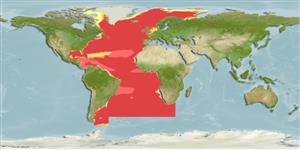
North Atlantic: single specimen from the Irminger Sea (Ref. 10523) and a single record from the eastern central Atlantic; also in the northwest Atlantic and western central Atlantic.
Grootte / Gewicht / Leeftijd
Maturiteit: Lm ? range ? - ? cm
Max length : 20.6 cm TL (female)
Korte beschrijving
Determinatiesleutels | Morfologie | Morfometrie
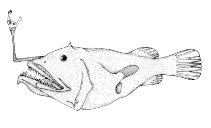
Dorsale zachte stralen (totaal) : 6; Anale zachte stralen: 4. Characterized by having esca with stout, internally pigmented anterior appendage less than half the length of escal bulb and bearing numerous tapering filaments at distal tip and 2-3 filaments along anterior margin; absence of medial escal appendages; terminal escal papilla truncated with two bilaterally placed distal pigment spots in specimens 20mm and larger; posterior escal appendage approximately one-half of escal bulb to longer than escal bulb in large specimens; distal one-third to one-half of posterior appendage split into numerous filaments; absence of lateral escal appendages; filamentous anterolateral escal appendage, less than length of anterior appendage; distal tips of filaments of anterior and posterior escal appendages and entire length of filaments of anterolateral escalappendage with dark melanophores in specimens 124mm and larger; relatively long and narrow subopercle, without indentation on posterodorsal margin; ventral fork length of opercle 24.4-26.0% SL; ratio of lengths of dorsal and ventral forks of opercle 0.46-0.53; absence of epibranchial teeth; presence of teeth on pharyngobranchial II; upper jaw teeth 26-70, lower jaw teeth 27-65; teeth on vomer 5-8; dorsal fin rays 6; anal fin rays 4; pectoral fin rays 15-17; head length 35.7-42.5% SL; head depth 32.2-45.0% SL; length of premaxilla 28.8-33.5% SL; length of lower jaw 39.9-47.5% SL; illicial length 23.8-40.2% SL (Ref. 86949).
Also mesopelagic (Ref. 10524).
Levenscyclus en paargedrag
Maturiteit | Voortplanting | Paaien | Eieren | Fecunditeit | Larven
Bertelsen, E., 1990. Oneirodidae. p. 498-507. In J.C. Quero, J.C. Hureau, C. Karrer, A. Post, and L. Saldanha (eds.) Check-list of the fishes of the eastern tropical Atlantic (CLOFETA). JNICT, Lisbon; SEI, Paris; and UNESCO, Paris. Vol. 1. (Ref. 10524)
Status op de Rode Lijst van het IUCN (Ref. 130435: Version 2025-2 (Global))
Gevaar voor de mens
Harmless
Gebruik door de mens
Tools
Speciale rapporten
Download XML
Internetbronnen
Schattingen op basis van modellen
Gewenste temperatuur (Ref.
123201): 0.5 - 17.1, mean 4.6 °C (based on 1541 cells).
Fylogenetische diversiteitsindex (Ref.
82804): PD
50 = 0.5000 [Uniqueness, from 0.5 = low to 2.0 = high].
Bayesian length-weight: a=0.01000 (0.00244 - 0.04107), b=3.04 (2.81 - 3.27), in cm total length, based on all LWR estimates for this body shape (Ref.
93245).
Trofisch niveau (Ref.
69278): 4.2 ±0.7 se; based on size and trophs of closest relatives
Weerstandsvermogen (Ref.
120179): Gemiddeld, minimale populatieverdubbelingstijd 1,4-4,4 jaar (Preliminary K or Fecundity.).
Kwetsbaarheid van de visserij (Ref.
59153): Low vulnerability (11 of 100).
🛈