>
Blenniiformes (Blennies) >
Tripterygiidae (Triplefin blennies) > Tripterygiinae
Etymology: Enneapterygius: Greek, ennea = nine times + Greek, pterygion = little fin (Ref. 45335).
Entorno: milieu / zona climática / rango de profundidad / gama de distribución
Ecología
marino asociado a arrecife; rango de profundidad 1 - 14 m (Ref. 88983), usually 1 - ? m (Ref. 88983). Tropical
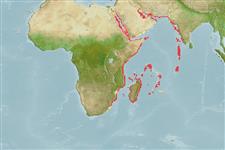
Western Indian Ocean: Red Sea, along East African coast to southern Kwazulu-Natal, Mauritius, Seychelles, Comoros and St. Brandon Shoals; not recorded in Gulf of Oman.
Tamaño / Peso / Edad
Madurez: Lm ? range ? - ? cm
Max length : 2.5 cm SL macho / no sexado; (Ref. 88983)
Descripción breve
Claves de identificación | Morfología | Morfometría
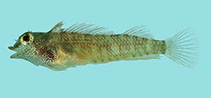
Espinas dorsales (total) : 14 - 16; Radios blandos dorsales (total) : 9 - 10; Espinas anales: 1; Radios blandos anales: 17 - 18; Vértebra: 34 - 36. This species is distinguished by the following characters: low first dorsal fin, brown and green radii around the eye, males with yellow body and melanophores on head to base of pectoral fins, females with yellow-green body, brown stripe on nose and orange bar below eye; further, D III + XI-XIII + 9-10 (usually III + XII + 10); A I, 17-18 (usually 18 rays); pectoral fin 15: usually 3, 5, 7; lateral line with pored scales12-14, notched scales 20-23 (usually 22); longitudinal scale series 31; dentary pores 3 + 1 + 3 ; head 3.2-3.8 in SL; eye 2.9-3.7 in HL; nape partially scaled, abdomen no scales, single row of scales at base of caudal fin; supratemporal sensory canal crescent-shaped; supraorbital cirrus small and pointed; first dorsal fin about equal in height to second in males, lower in females (Ref. 57774, 88983).
Body shape (shape guide): fusiform / normal.
Adults occur in shallow, sheltered waters, on hard corals; found on the upper part of coral reefs, usually along the reef margin in depths of about 1 m, often on corals covered by low algae. Also found in bays or sheltered lagoons (Ref. 88983). Eggs are hemispherical and covered with numerous sticky threads that anchor them in the algae on the nesting sites (Ref. 240). Larvae are planktonic which occur primarily in shallow, nearshore waters (Ref. 94114).
Ciclo vital y comportamiento de apareamiento
Madurez | Reproducción | Puesta | Huevos | Fecundidad | Larva
Holleman, W. and S.V. Bogorodsky, 2012. A review of the blennioid fish family Tripterygiidae (Perciformes) in the Red Sea, with description of Enneapterygius qirmiz, and reinstatement of Enneapterygius altipinnis Clark, 1980. Zootaxa 3152:36-60. (Ref. 88983)
Situación en la Lista Roja de la UICN (Ref. 130435: Version 2025-2 (Global))
Amenaza para el ser humano
Harmless
Usos humanos
Pesquerías: sin interés
Herramientas
Informes especiales
Descargar XML
Fuentes de Internet
Estimaciones basadas en modelos
Temperatura preferida (Referencia
123201): 24.8 - 29.1, mean 27.5 °C (based on 669 cells).
Índice de diversidad filogenética (Referencia
82804): PD
50 = 0.5000 [Uniqueness, from 0.5 = low to 2.0 = high].
Bayesian length-weight: a=0.00776 (0.00332 - 0.01813), b=3.09 (2.89 - 3.29), in cm total length, based on LWR estimates for this (Sub)family-body shape (Ref.
93245).
Nivel trófico (Referencia
69278): 3.1 ±0.3 se; based on size and trophs of closest relatives
Resiliencia (Referencia
120179): Alto, población duplicada en un tiempo mínimo inferior a 15 meses (Preliminary K or Fecundity.).
Vulnerabilidad pesquera (Ref.
59153): Low vulnerability (10 of 100).
🛈
Nutrientes (Ref.
124155): Calcium = 639 [201, 4,859] mg/100g; Iron = 4.09 [1.07, 11.80] mg/100g; Protein = 18.5 [16.2, 20.7] %; Omega3 = 0.151 [0.023, 1.087] g/100g; Selenium = 83.3 [9.6, 578.8] μg/100g; VitaminA = 25.9 [1.7, 343.2] μg/100g; Zinc = 8.88 [3.11, 20.04] mg/100g (wet weight);