Entorno: milieu / zona climática / rango de profundidad / gama de distribución
Ecología
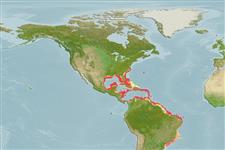
marino asociado a arrecife; no migratorio; rango de profundidad 5 - 330 m (Ref. 13442), usually 70 - 330 m (Ref. 13442). Subtropical; 35°N - 27°S, 98°W - 33°W (Ref. 5222)
Western Atlantic: North Carolina, USA to southern Brazil, including the Gulf of Mexico, Caribbean, and Bermuda; strays occur north to Massachusetts.
Longitud en la primera madurez / Tamaño / Peso / Edad
Madurez: Lm 54.4, range 35 - 98 cm
Max length : 125 cm TL macho / no sexado; (Ref. 26340); common length : 50.0 cm TL macho / no sexado; (Ref. 5217); peso máximo publicado: 23.0 kg (Ref. 9710); edad máxima reportada: 25 años (Ref. 5222)
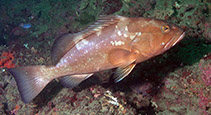
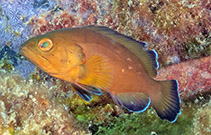
Espinas dorsales (total) : 11; Radios blandos dorsales (total) : 16 - 17; Espinas anales: 3; Radios blandos anales: 8 - 10. Color of head and body dark reddish brown, shading to pink or reddish below. Opercle with 3 flat spines, the middle one being the largest. Vertical fins angulate in larger fish. Pelvic fins shorter than pectorals and inserted slightly behind ventral and pectoral-fin base. Bases of soft dorsal and anal fins covered with scales and thick skin. No saddle on caudal peduncle. Interspinous membranes not incised (Ref. 26938); head length 2.3-2.5 times in SL; convex interorbital; subangular preopercle, serrae at angle slightly enlarged; straight upper edge of operculum; posterior and anterior nostrils subequal (Ref. 89707).
Body shape (shape guide): fusiform / normal; Cross section: compressed.
Adults occur mainly over rocky and muddy bottoms. Uncommon around coral reefs. Usually rest on the bottom (Ref. 9710). Juveniles may be found in shallow water, but adults are usually taken from depths of 70-330 m (Ref. 13442). Feed on a wide variety of fishes and invertebrates. Are protogynous hermaphrodites (Ref. 55367). Most females transform to males between ages 7 to 14. Susceptible to red tide toxin (Ptychodiscus brevi) (Ref. 5222). Marketed fresh or frozen. The world record for hook and line, 39 lbs., from Cape Canaveral, Florida (Ref. 13442).
Sex change occurs at 75.5 cm TL and 9.5 years of age (Ref. 55367).
Heemstra, P.C. and J.E. Randall, 1993. FAO Species Catalogue. Vol. 16. Groupers of the world (family Serranidae, subfamily Epinephelinae). An annotated and illustrated catalogue of the grouper, rockcod, hind, coral grouper and lyretail species known to date. Rome: FAO. FAO Fish. Synop. 125(16):382 p. (Ref. 5222)
Situación en la Lista Roja de la UICN (Ref. 130435: Version 2025-2 (Global))
Amenaza para el ser humano
Usos humanos
Pesquerías: comercial; pesca deportiva: si; Acuario: Acuarios públicos
Herramientas
Informes especiales
Descargar XML
Fuentes de Internet
Estimaciones basadas en modelos
Temperatura preferida (Referencia
123201): 11.5 - 25.7, mean 19.1 °C (based on 233 cells).
Índice de diversidad filogenética (Referencia
82804): PD
50 = 0.5000 [Uniqueness, from 0.5 = low to 2.0 = high].
Bayesian length-weight: a=0.01413 (0.00916 - 0.02179), b=3.01 (2.89 - 3.13), in cm total length, based on LWR estimates for this species & Genus-body shape (Ref.
93245).
Nivel trófico (Referencia
69278): 3.5 ±0.5 se; based on diet studies.
Generation time: 8.9 (6.9 - 10.9) years. Estimated as median ln(3)/K based on 15
growth studies.
Resiliencia (Referencia
120179): Medio, población duplicada en un tiempo mínimo de 1.4-4.4 años (K=0.1-0.18; tm=4-6; tmax=25; Fec=1.4 million).
Prior r = 0.64, 95% CL = 0.42 - 0.96, Based on 2 full stock assessments.
Vulnerabilidad pesquera (Ref.
59153): High vulnerability (64 of 100).
🛈
Vulnerabilidad climática (Ref.
125649): High vulnerability (63 of 100).
🛈
Nutrientes (Ref.
124155): Calcium = 9.76 [3.62, 22.19] mg/100g; Iron = 0.41 [0.20, 0.85] mg/100g; Protein = 19.1 [17.5, 20.5] %; Omega3 = 0.176 [0.093, 0.338] g/100g; Selenium = 30.3 [14.5, 64.1] μg/100g; VitaminA = 65.2 [15.5, 263.8] μg/100g; Zinc = 0.743 [0.486, 1.122] mg/100g (wet weight);