>
Blenniiformes (Blennies) >
Blenniidae (Combtooth blennies) > Salariinae
Etymology: Parablennius: Greek, para = the side of + Greek, blennios = mucus (Ref. 45335).
More on author: Pallas.
Environnement : milieu / zone climatique / profondeur / gamme de distribution
Écologie
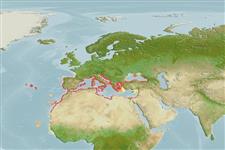
marin démersal; non migrateur; profondeur 0 - 1 m. Subtropical; 47°N - 9°N, 32°W - 42°E
Eastern Atlantic: Loire, France to Morocco including the Mediterranean and Black Sea.
Taille / Poids / Âge
Maturité: Lm ? range ? - ? cm
Max length : 20.0 cm TL mâle / non sexé; (Ref. 3397); common length : 12.5 cm TL mâle / non sexé; (Ref. 3397)
Épines dorsales (Total) : 11; Rayons mous dorsaux (Total) : 21; Épines anales: 0; Rayons mous anaux: 21.
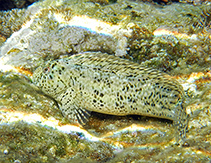
Body shape (shape guide): fusiform / normal.
Facultative air-breathing in the genus (Ref. 126274); Are residents in intertidal areas with homing behavior (Ref. 32612). They are found between pebbles or at margins of steep, filamentous algae-covered rocks exposed to sunlight. They make underwater 'flight' over long distances. Feed almost exclusively on algae (Ref. 205), favoring the algae Ulva (Ref. 94105). Spawns from May to July. Oviparous. Eggs are demersal and adhesive (Ref. 205), and are attached to the substrate via a filamentous, adhesive pad or pedestal (Ref. 94114). Larvae are planktonic, often found in shallow, coastal waters (Ref. 94114).
Cycle de vie et comportement reproducteur
Maturité | Reproduction | Frai | Œufs | Fécondité | Larves
Oviparous, distinct pairing (Ref. 205).
Zander, C.D., 1986. Blenniidae. p. 1096-1112. In P.J.P. Whitehead, M.-L. Bauchot, J.-C. Hureau, J. Nielsen and E. Tortonese (eds.) Fishes of the North-eastern Atlantic and the Mediterranean, volume 3. UNESCO, Paris. (Ref. 5981)
Statut dans la liste rouge de l'IUCN (Ref. 130435: Version 2025-2 (Global))
Menace pour l'homme
Harmless
Utilisations par l'homme
Pêcheries: intérêt commercial mineur; Aquarium: Commercial
Outils
Articles particuliers
Télécharger en XML
Sources Internet
Estimations basées sur des modèles
Température préférée (Réf.
123201): 15.1 - 20.4, mean 18.6 °C (based on 485 cells).
Indice de diversité phylogénétique (Réf.
82804): PD
50 = 0.5000 [Uniqueness, from 0.5 = low to 2.0 = high].
Bayesian length-weight: a=0.01230 (0.00915 - 0.01654), b=3.00 (2.94 - 3.06), in cm total length, based on LWR estimates for this species (Ref.
93245).
Niveau trophique (Réf.
69278): 2.1 ±0.0 se; based on diet studies.
Résilience (Réf.
120179): Milieu, temps minimum de doublement de population : 1,4 à 4,4 années (Preliminary K or Fecundity.).
Vulnérabilité de la pêche (Ref.
59153): Low vulnerability (10 of 100).
🛈
Nutriments (Ref.
124155): Calcium = 179 [81, 438] mg/100g; Iron = 1.39 [0.76, 2.73] mg/100g; Protein = 18.6 [17.4, 19.9] %; Omega3 = 0.218 [0.103, 0.459] g/100g; Selenium = 9.41 [4.21, 24.25] μg/100g; VitaminA = 16.9 [4.0, 68.2] μg/100g; Zinc = 1.47 [0.95, 2.33] mg/100g (wet weight);