Môi trường: môi trường / vùng khí hậu / Mức độ sâu / phạm vi phân phối
Sinh thái học
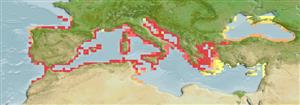
biển; thuộc về nước lợ gần đáy. Subtropical; 46°N - 33°N, 10°W - 42°E
Eastern Atlantic: Atlantic coast from France to Morocco; also in the Mediterranean and Black seas and in the Suez Canal.
Bộ gần gũi / Khối lượng (Trọng lượng) / Tuổi
Chín muồi sinh dục: Lm ? range ? - ? cm
Max length : 13.8 cm TL con đực/không giới tính; (Ref. 118193)
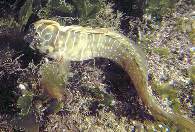
Các tia vây lưng cứng (tổng cộng) : 11 - 13; Các vây lưng mềm (tổng cộng) : 22 - 25; Tia cứng vây hậu môn: 2; Tia mềm vây hậu môn: 23 - 26. Diagnosis: Mature males with well-developed head-crest and anal gland in the first two anal-fin rays; sneaker males much smaller than nesting males and do not display male secondary sexual characters (Ref. 94108).
Body shape (shape guide): fusiform / normal.
Facultative air-breathing (Ref. 126274); Adults occur in the intertidal zone and shallow bottoms, on rocks or sand between pebbles and vegetation (Ref. 5981). Often in brackish waters down to 5 ppt (Ref. 5981). Inhabit crevices or piddock holes, males remain in cavities above water-level during low tide (Ref. 5981). Feed on benthic invertebrates, mainly mollusks, also algae (Ref. 5981). Also ingest large amounts of aquatic insects and pupae (Ref. 94105). Oviparous (Ref. 205). Mature males adopt a passive role during courtship, rarely court females, do not defend nest territory, but provide parental care to eggs. Sneaker males assume a female-like behavior in order to approach the nests of nesting males and parasitically fertilize the eggs (Ref. 94113). Eggs are demersal and adhesive (Ref. 205). Has been reared in captivity (Ref. 35421).
Males court by nodding and undulating movements and drive females to spawning place by biting and butting (Ref. 5981) though this event is rarely done by the males, more or less adopting a passive role in the courtship (Ref 94113). Additionally, males don't defend a territory around the nest (Ref. 94113) though they guard eggs from several females (Ref. 5981, 94113).
Zander, C.D., 1986. Blenniidae. p. 1096-1112. In P.J.P. Whitehead, M.-L. Bauchot, J.-C. Hureau, J. Nielsen and E. Tortonese (eds.) Fishes of the North-eastern Atlantic and the Mediterranean, volume 3. UNESCO, Paris. (Ref. 5981)
Tình trạng Sách đỏ IUCN (Ref. 130435: Version 2025-2 (Global))
Mối đe dọa đối với con người
Harmless
Sử dụng của con người
Các nghề cá: các nghề cá là sinh kế
Các công cụ
Báo cáo đặc biệt
Tải xuống XML
Các nguồn internet
Ước tính dựa trên mô hình
Nhiệt độ ưa thích (Tài liệu tham khảo
123201): 15 - 21.2, mean 18.8 °C (based on 615 cells).
Chỉ số đa dạng phát sinh loài (Tài liệu tham khảo
82804): PD
50 = 0.7500 [Uniqueness, from 0.5 = low to 2.0 = high].
Bayesian length-weight: a=0.01096 (0.00854 - 0.01407), b=3.01 (2.94 - 3.08), in cm total length, based on LWR estimates for this species (Ref.
93245).
Mức dinh dưỡng (Tài liệu tham khảo
69278): 3.6 ±0.0 se; based on diet studies.
Generation time: 2.2 ( na - na) years. Estimated as median ln(3)/K based on 1
growth studies.
Thích nghi nhanh (Tài liệu tham khảo
120179): Chiêù cao, thời gian nhân đôi của chủng quần tối thiểu là dưới 15 tháng (K=0.50).
Sự dễ bị tổn thương của nghề đánh cá (Ref.
59153): Low to moderate vulnerability (25 of 100).
🛈
Chất dinh dưỡng (Ref.
124155): Calcium = 127 [21, 405] mg/100g; Iron = 1.39 [0.52, 4.55] mg/100g; Protein = 4.16 [0.45, 7.88] %; Omega3 = 0.443 [0.183, 1.088] g/100g; Selenium = 8.2 [1.8, 25.0] μg/100g; VitaminA = 25.1 [8.9, 69.6] μg/100g; Zinc = 1.24 [0.59, 2.46] mg/100g (wet weight);