>
Ophidiiformes (Cusk eels) >
Ophidiidae (Cusk-eels) > Neobythitinae
Etymology: Abyssobrotula: Greek, abyssos, deep, depth + Latin, brotula = little bud, shoot (Ref. 45335).
Eponymy: This is not a true eponym as it is named after a ship. [...] (Ref. 128868), visit book page.
More on author: Nielsen.
Entorno: milieu / zona climática / rango de profundidad / gama de distribución
Ecología
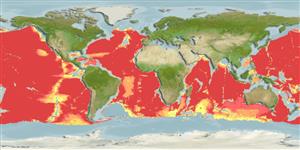
marino batipelágico; rango de profundidad 3110 - 7965 m (Ref. 130003). Deep-water; 60°N - 60°S, 180°E - 180°E
In deep waters of tropical and subtropical areas of all oceans. 3 specimens from the Gulf of Guinea (Ref. 3686).
Tamaño / Peso / Edad
Madurez: Lm ? range ? - ? cm
Max length : 16.5 cm SL macho / no sexado; (Ref. 3686)
Descripción breve
Claves de identificación | Morfología | Morfometría
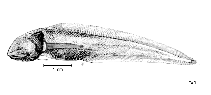
Head short with downward inflection. Snout swollen. Eyes small. Poorly developed opercular spine. Anterior gill arch with 8-11 developed gill rakers. Precaudal vertebrae 18-21.
The previous maximum depth reported was 8730 m, supposedy the deepest fish caught. However there was a mistake in the logbook of the station, the correct depht is now 7965 m, the third deepes fish 9as of Novemeber 2023 (Ref. 130003). Uncommon species (Ref. 34024). Reproductive strategy possibly similar to other members of this family being oviparous, with oval pelagic eggs floating in a gelatinous mass (Ref. 205).
Ciclo vital y comportamiento de apareamiento
Madurez | Reproducción | Puesta | Huevos | Fecundidad | Larva
Nielsen, J.G., 1990. Ophidiidae. p. 564-573. In J.C. Quero, J.C. Hureau, C. Karrer, A. Post and L. Saldanha (eds.) Check-list of the fishes of the eastern tropical Atlantic (CLOFETA). JNICT, Lisbon; SEI, Paris; and UNESCO, Paris. Vol. 2. (Ref. 3686)
Situación en la Lista Roja de la UICN (Ref. 130435: Version 2025-2 (Global))
Amenaza para el ser humano
Harmless
Usos humanos
Pesquerías: sin interés
Herramientas
Informes especiales
Descargar XML
Fuentes de Internet
Estimaciones basadas en modelos
Temperatura preferida (Referencia
123201): 0.7 - 2.4, mean 1.4 °C (based on 34031 cells).
Índice de diversidad filogenética (Referencia
82804): PD
50 = 0.7500 [Uniqueness, from 0.5 = low to 2.0 = high].
Bayesian length-weight: a=0.00380 (0.00165 - 0.00876), b=3.14 (2.93 - 3.35), in cm total length, based on LWR estimates for this (Sub)family-body shape (Ref.
93245).
Nivel trófico (Referencia
69278): 3.5 ±0.6 se; based on size and trophs of closest relatives
Resiliencia (Referencia
120179): Medio, población duplicada en un tiempo mínimo de 1.4-4.4 años (Assuming tmax>3).
Vulnerabilidad pesquera (Ref.
59153): Low vulnerability (10 of 100).
🛈