Ambiente: milieu / zona climatica / distribuzione batimetrica / gamma di distribuzione
Ecologia
; acqua dolce benthopelagico; potamodromo (Ref. 35461); distribuzione batimetrica 5 - 20 m (Ref. 6898). Temperate; 54°N - 19°N, 105°E - 143°E
Asia: throughout the Amur basin (Ref. 1441); eastern Asia from the Amur basin to northern Vietnam, Japan and islands of Hainan and Taiwan (Ref. 26334). Recorded from Mekong basin in Laos which apparently the result of introduction, either in Laos, or more likely upriver in Mekong basin in China (Ref. 37786).
Lunghezza alla prima maturità / Dimensione / Peso / Età
Maturità: Lm 30.5, range 29 - 32 cm
Max length : 67.0 cm TL maschio/sesso non determinato; (Ref. 126870); common length : 33.0 cm TL maschio/sesso non determinato; (Ref. 1441); common length :40.6 cm TL (female); peso massimo pubblicato: 3.0 kg (Ref. 56557); Età massima riportata: 15 anni (Ref. 56557)
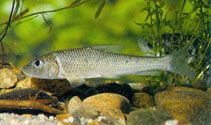
Vertebre: 40 - 42. Body spots absent in adults. Elongated body with slightly convex dorsal profile. Head length longer than body depth. Snout length much longer than postorbital head length. Lips well developed, lateral lobes of lower lip broad and thick, with folds, the median process small. Barbel length slightly thick, shorter or equal to eye diameter. Dorsal spine strong, 2/3 of HL. Origin of dorsal fin nearer the tip of snout than the caudal base. Gill rakers more than 15 (Ref. 38453). Anal fin with 6 1/2 branched rays; last simple dorsal rays ossified, spine-like (Ref. 43281).
Body shape (shape guide): fusiform / normal.
Omnivorous, feeding mainly on benthic invertebrates (Ref. 41299). Females are larger than males (Ref. 1441).
Nakabo, T., 2002. Fishes of Japan with pictorial keys to the species, English edition I. Tokai University Press, Japan, pp v-866. (Ref. 41299)
Stato della Lista Rossa IUCN (Ref. 130435: Version 2025-2 (Global))
Minaccia per l'uomo
Harmless
Usi umani
Pesca: commerciale; Pesce da pesca sportiva: si
Strumenti
Rapporti speciali
Scarica XML
Fonti Internet
Stime basate su modelli
Indice di diversità filogenetica (Fonte Biblio.
82804): PD
50 = 0.5002 [Uniqueness, from 0.5 = low to 2.0 = high].
Bayesian length-weight: a=0.00708 (0.00586 - 0.00856), b=3.10 (3.05 - 3.15), in cm total length, based on LWR estimates for this species (Ref.
93245).
Livello trofico (Fonte Biblio.
69278): 3.5 ±0.5 se; based on size and trophs of closest relatives
Generation time: 6.6 ( na - na) years. Estimated as median ln(3)/K based on 2
growth studies.
Resilienza (Fonte Biblio.
120179): Medio, tempo minimo di raddoppiamento della popolazione 1.4 - 4.4 anni (tm=3-4; k=0.16-0.19).
Vulnerabilità della pesca (Ref.
59153): Moderate to high vulnerability (55 of 100).
🛈