>
Tetraodontiformes (Puffers and filefishes) >
Molidae (Molas or Ocean Sunfishes)
Etymology: Mola: Latin, mola, -ae = stone mill; because of the shape of this fish (Ref. 45335).
More on author: Linnaeus.
Environnement : milieu / zone climatique / profondeur / gamme de distribution
Écologie
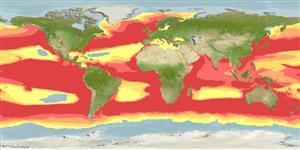
marin pelagic-oceanic; océanodrome (Ref. 138310); profondeur 30 - 1515 m (Ref. 86942), usually 30 - 70 m (Ref. 90102). Subtropical; 12°C - 25°C (Ref. 37040); 75°N - 65°S, 180°W - 180°E
Circumglobal: tropical and temperate zones of all oceans.
Taille / Poids / Âge
Maturité: Lm ? range ? - ? cm
Max length : 333 cm TL mâle / non sexé; (Ref. 26340); poids max. publié: 1.3 t (Ref. 132224)
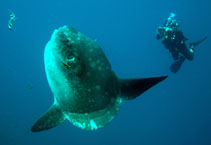
Épines dorsales (Total) : 0; Rayons mous dorsaux (Total) : 15 - 18; Épines anales: 0; Rayons mous anaux: 14 - 17. The scaleless body is covered with extremely thick, elastic skin. The caudal fin is replaced by a rudder-like structure called 'clavus'. Dorsal and anal fins very high with short base; in swimming, these fins are flapped synchronously from side to side and can propel the fish at surprisingly good speed. Pectorals small and rounded, directed upward (Ref. 6885). Mouth very small; teeth fused to form a parrot-like beak. Gills 4, a slit behind the last; gill openings reduced to a small hole at the base of the pectoral fins. Gas bladder absent in adults.
Body shape (shape guide): short and / or deep; Cross section: oval.
Molas are distinguished for their distinct morphological characters which include reduced/fused caudal elements, presence of a clavus in place of the caudal fin, absence of a swim bladder and a degenerate, cartilaginous skeleton (Ref. 86435). Adults are found on slopes adjacent to deep water where they come in for shelter and for seeking cleaner fishes. They are usually shy. However, they may become familiar with divers in some locations (Ref. 48637). Individuals often drift at the surface while lying on its side but can swim actively and are capable of directional movements otherwise (Ref. 86435). They swim upright and close to the surface. The dorsal fin often protrudes above the water. Females are larger than males (Ref. 86435). This species has been filmed in 480 m depth with the help of a camera equipped with baits (Lis Maclaren, pers. comm. 2005). Adults eat fishes, mollusks, zooplankton, jellyfish, crustaceans and brittle stars (Ref. 4925, 5951, 48637). A live colony of the cirripede Lepas anatifera were found attached to the anterior portion of the sunfish's esophagus that was stranded in the south coast of Terceira Island, Azores Archipelago in 2004. This association has apparent advantages for the goose barnacles such as a regular intake of food and protection both from hydrodynamic hazards and from predators: but for the sunfish, it is not clear whether it is neutral, of advantage or causes feeding problems since the attachment may obstruct the sunfish's esophagus (Ref. 55063). The sunfish is registered as the heaviest bony fish and as the one with the most eggs in the Guinness Book of World Records (Ref. 6472). Generally this species is not used as food fish; some people consider it as a delicacy (Ref. 30573). The fish can be utilized fresh and can be broiled (Ref. 9988). Some parts of the fish are used in Chinese medicine (Ref. 12166). Molas may contain the same toxin as puffers and porcupine fish (Ref. 13513). They do not adapt well in captivity (Ref. 12382, 37040). Juveniles are victims of California sea lions in Monterey Bay (Ref. 37040).
Produces very numerous and small eggs; 300 million eggs found in a 1.5 m long female (Ref. 4711). Oocytes in the ovaries develop in different stages suggesting Mola mola as a multiple spawner (Ref. 86440). This is the largest clutch estimate for this species (Ref. 53596).
Tortonese, E., 1990. Molidae. p. 1077-1079. In J.C. Quero, J.C. Hureau, C. Karrer, A. Post and L. Saldanha (eds.) Check-list of the fishes of the eastern tropical Atlantic (CLOFETA). JNICT, Lisbon; SEI, Paris; and UNESCO, Paris. Vol. 2. (Ref. 6952)
Statut dans la liste rouge de l'IUCN (Ref. 130435: Version 2025-2 (Global))
Menace pour l'homme
Poisonous to eat (Ref. 13513)
Utilisations par l'homme
Pêcheries: intérêt commercial mineur
Outils
Articles particuliers
Télécharger en XML
Sources Internet
Estimations basées sur des modèles
Température préférée (Réf.
123201): 5.3 - 20.5, mean 10.2 °C (based on 1286 cells).
Indice de diversité phylogénétique (Réf.
82804): PD
50 = 0.6562 [Uniqueness, from 0.5 = low to 2.0 = high].
Bayesian length-weight: a=0.03548 (0.02064 - 0.06098), b=3.06 (2.90 - 3.22), in cm total length, based on LWR estimates for this species & (Sub)family-body (Ref.
93245).
Niveau trophique (Réf.
69278): 3.1 ±0.41 se; based on food items.
Generation time: 7.4 ( na - na) years. Estimated as median ln(3)/K based on 1
growth studies.
Résilience (Réf.
120179): Faible, temps minimum de doublement de population : 4,5 à 14 années (K=0.49-0.3; tmax assumed > 15; Fec=300 million (batch fecundity)).
Vulnérabilité de la pêche (Ref.
59153): High to very high vulnerability (67 of 100).
🛈
Vulnérabilité climatique (Ref.
125649): Moderate vulnerability (43 of 100).
🛈
Nutriments (Ref.
124155): Calcium = 19.4 [7.7, 46.5] mg/100g; Iron = 0.967 [0.481, 2.428] mg/100g; Protein = 18.7 [16.3, 21.0] %; Omega3 = 0.248 [0.113, 0.569] g/100g; Selenium = 57.6 [22.6, 165.5] μg/100g; VitaminA = 3.53 [0.76, 16.47] μg/100g; Zinc = 0.381 [0.234, 0.617] mg/100g (wet weight);