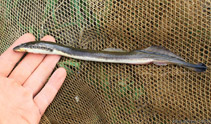
>
Petromyzontiformes (Lampreys) >
Petromyzontidae (Northern lampreys) > Lampetrinae
Etymology: Eudontomyzon: eu-, a Greek intensive (good, well or very); odontos (Gr.) tooth, referring to numerous radially arranged teeth of E. danfordi; myzon (Gr.), to suck (borrowed from Petromyzon), referring to their suctorial behavior (See ETYFish); mariae: In honor of Berg’s second wife Maria (née Ivanova), “who examined many thousands of river lampreys from the mouth of the Neva and other streams, falling into the Finnish Gulf” (See ETYFish).
Eponymy: Maria Mikhailovna Berg née Ivanova was (1922) the second wife of the author. [...] (Ref. 128868), visit book page.
More on author: Berg.
Taxonomic Remarks
This species needs a complete re-evaluation Renaud (2011; Re. 89241:41), and may be a complex of species. Please send references, or more studies are needed.
Entorno: milieu / zona climática / rango de profundidad / gama de distribución
Ecología
; agua dulce demersal; potamodromo. Temperate; 57°N - 41°N, 14°E - 49°E (Ref. 59043)
Europe: Drainages of the Baltic Sea (Odra, Vistula, Neman), northern Black Sea (Sava, Drava, Danube [except Tisza, Timis, and Cerna rivers], Prut, Dnieper, Dniester, Don, Kuban, and in rivers of Georgia from Bzyb' in south to Chorokhi in north), Aegean Sea (Vardar), and Caspian Sea (Volga - Sura River) (Ref. 58030). One record in the upper Morava system (Czechia) (Ref. 59043).
Tamaño / Peso / Edad
Madurez: Lm ? range ? - ? cm
Max length : 22.2 cm TL macho / no sexado; (Ref. 12283); common length : 18.0 cm TL macho / no sexado; (Ref. 556); edad máxima reportada: 7 años (Ref. 12283)
Espinas dorsales (total) : 0; Radios blandos dorsales (total) : 0; Espinas anales: 0; Radios blandos anales: 0. Adults: 12.0-22.2 cm TL. Body wet weight of 37 individuals 13.1-19.5 cm TL, 3.61-12.69 g. Body proportions, as percentage of TL (based on 39 specimens measuring 12.3-19.5 cm TL): prebranchial length, 6.9-12.1; branchial length, 8.5-12.3; trunk length, 44.9-54.4; tail length, 24.3-31.3; cloacal slit length, 0.4-2.2; eye length, 0.7-2.1; disc length, 2.2-5.8; prenostril length, 2.5-6.5; snout length, 2.7-7.6; postocular length, 2.4-3.7. The urogenital papilla length, as a percentage of branchial length, in eight spawning males measuring 14.35-18.4 cm TL, 25.0-38.6. Trunk myomeres, 60-73. Dentition: Most labial teeth are villiform; supraoral lamina, usually only 2 unicuspid teeth, but in less than 10% of cases, 1-3 small unicuspid teeth may also be found on the bridge; infraoral lamina, 5-10 usually unicuspid teeth, but 1-2 lateralmost teeth may be bicuspid; usually 3 endolaterals on each side (83%), but 4 (11%), 1 (4%), and 2 (2%) also found; endolateral formula, typically 1-2-2 (26%), 1-2-1 (22%), 2-2-1 (13%), 2-2-2 (11%), but also 1-1-1, 2-2-3, 1-1-2-2 (each 6%), 2, 1-1-2-1 (each 4%), 1-2, 1-2-2-2 (each 2%) - Naseka et al. (2009) reported the following additional formulae from the syntypic series, including a count of 5 endolaterals: 1-1-2, 1-3-1, 2-1-1, 2-3-2, 1-2-2-1, 2-1-2-2, 1-1-2-1-1; 2-5 rows of anterials; first row of anterials, 5-10 unicuspid teeth, exceptionally, one lateralmost tooth may be bicuspid; 1-4 rows of exolaterals; rows of posterials, 0-3 (absent in 10% of individuals only); first row of posterials, either complete (continuous) with 12-20 unicuspid teeth (62% of individuals) or incomplete (discontinuous) with 1-12 unicuspid teeth (38% of individuals) or entirely absent (very rarely) - Naseka et al. (2009) reported the following additional counts from the syntypic series: complete row with 10 unicuspid and 1 bicuspid teeth; incomplete row with 13-17 unicuspid teeth and with 4 unicuspid and one bicuspid teeth; transverse lingual lamina, 3-7 unicuspid teeth, the median one enlarged (in 79% of individuals, the median cusp is both higher and wider, while in 21% of individuals it is wider, but not noticeably higher, than the flanking cusps); longitudinal lingual laminae each with 5-11 unicuspid teeth. Velar tentacles, 7-12, with tubercles. No dark blotch near the apex of the second dorsal fin. Lateral line neuromasts unpigmented or darkly pigmented, at least on the ventral aspect. Extent of caudal fin pigmentation (- = absence to trace; + = 1% to under 25%; ++ = 25% to under 75%; +++ = 75% or more): - (7%), + (3%), ++ (13%), +++ (77%). Caudal fin shape, spade-like (97% of individuals), rarely rounded. Oral fimbriae, 88-98 (Ref. 89241). With 62-73 trunk myomeres. The caudal fin is dark grey to black (Ref. 59043).
Body shape (shape guide): eel-like; Cross section: circular.
Adults are found in freshwater; in brooks, rivers, and lakes (Ref. 89241). They inhabit the mountain and foothill zones of watercourses containing clear water with a strong current and gravel-sand substrate. The ammocoetes larvae live in detritus-rich sand-mud substrates in areas of weak current, frequently beneath overhanging banks. Ammocoetes feed on diatoms and detritus; adults don't feed. Metamorphosis occurs in September in Poland and Slovakia and in July in the Ukraine. Ammocoetes used as live bait (Ref. 12283). Adults are preyed upon by Esox lucius (Ref. 89241), the chub (Leuciscus cephalus) and other predators in the period of their spawning (beginning of May to beginning of June). Mature individuals form spawning aggregations (Ref. 59043). Spawning occurs on gravel and sand substrates, also possibly over hard white clay (Ref. 58030), in late April - early May in the Ukraine. Fecundity, 1,950-7,106 eggs/female (Ref. 89241). Adults are nonparasitic. However, rare cases of ectoparasitism have been reported in Jelesná Brook, Slovakia and the Prut River, Ukraine (Ref. 89241).
Ciclo vital y comportamiento de apareamiento
Madurez | Reproducción | Puesta | Huevos | Fecundidad | Larva
Spawning individuals come out in open day light. Males dig a shallow nest in areas with moderate current. Spawners form aggregations. Spawners die afterwards. Ammocoetes last 3.5 to 4.5 years. They metamorphose in September - December (Ref. 59043).
Holcík, J. and C.B. Renaud, 1986. Eudontomyzon mariae (Berg, 1931). p. 165-185. In J. Holcík (ed.) The Freshwater fishes of Europe. Vol.1, Part I, Petromyzontiformes. (Ref. 12283)
Situación en la Lista Roja de la UICN (Ref. 130435: Version 2025-2 (Global))
Amenaza para el ser humano
Harmless
Usos humanos
Pesquerías: sin interés; carnada: usually
Herramientas
Informes especiales
Descargar XML
Fuentes de Internet
Estimaciones basadas en modelos
Índice de diversidad filogenética (Referencia
82804): PD
50 = 0.5312 [Uniqueness, from 0.5 = low to 2.0 = high].
Bayesian length-weight: a=0.00132 (0.00060 - 0.00290), b=2.99 (2.80 - 3.18), in cm total length, based on LWR estimates for this (Sub)family-body shape (Ref.
93245).
Nivel trófico (Referencia
69278): 3.7 ±0.6 se; based on size and trophs of closest relatives
Resiliencia (Referencia
120179): Bajo, población duplicada en un tiempo mínimo de 4.5-14 años (Semelparous species, assuming tm (= tmax) > 4).
Vulnerabilidad pesquera (Ref.
59153): Low to moderate vulnerability (31 of 100).
🛈