>
Anguilliformes (Eels and morays) >
Ophichthidae (Snake eels) > Ophichthinae
Etymology: Cirricaecula: Latin, cirrus = curl fringe + latin, caeculus = blind (Ref. 45335).
Eponymy: Dr Martin Wiggo Johnson (1893–1984) was an American oceanographer. [...] (Ref. 128868), visit book page.
More on author: Schultz.
Ambiente: milieu / zona climatica / distribuzione batimetrica / gamma di distribuzione
Ecologia
marino associati a barriera corallina. Tropical; 12°N - 11°N
Western Central Pacific: Rongerik Atoll, Marshall Islands.
Dimensione / Peso / Età
Maturità: Lm ? range ? - ? cm
Max length : 40.0 cm maschio/sesso non determinato; (Ref. 1602)
Breve descrizione
Chiavi di identificazione | Morfologia | Morfometria
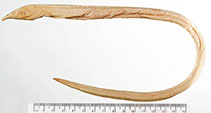
Spine dorsali (totale) : 0; Raggi dorsali molli (totale) : 0; Spine anali: 0; Raggi anali molli: 0. This species is unique among ophichthids by its combination of no fins, a long and pointed upper snout, and cirri on the upper lips. TL to 40 cm.
Body shape (shape guide): eel-like; Cross section: oval.
Type specimens collected from the surge-washed sand patch at Rongerik Atoll (Ref. 1602).
Ciclo vitale e comportamento di accoppiamento
Maturità | Riproduzione | Deposizione | Uova | Fecondità | Larve
Myers, R.F., 1991. Micronesian reef fishes. Second Ed. Coral Graphics, Barrigada, Guam. 298 p. (Ref. 1602)
Stato della Lista Rossa IUCN (Ref. 130435: Version 2025-2 (Global))
Minaccia per l'uomo
Harmless
Usi umani
Pesca: di nessun interesse
Strumenti
Rapporti speciali
Scarica XML
Fonti Internet
Stime basate su modelli
Indice di diversità filogenetica (Fonte Biblio.
82804): PD
50 = 0.7500 [Uniqueness, from 0.5 = low to 2.0 = high].
Bayesian length-weight: a=0.00093 (0.00041 - 0.00214), b=2.99 (2.79 - 3.19), in cm total length, based on LWR estimates for this (Sub)family-body shape (Ref.
93245).
Livello trofico (Fonte Biblio.
69278): 3.6 ±0.6 se; based on size and trophs of closest relatives
Resilienza (Fonte Biblio.
120179): Alto, tempo minimo di raddoppiamento della popolazione meno di 15 mesi (Preliminary K or Fecundity.).
Vulnerabilità della pesca (Ref.
59153): Low vulnerability (13 of 100).
🛈