>
Cypriniformes (Carps) >
Cyprinidae (Minnows or carps) > Labeoninae
Etymology: Lobocheilos: Latin, lobus = lobe + Greek, cheilos = lip (Ref. 45335).
Environnement : milieu / zone climatique / profondeur / gamme de distribution
Écologie
; eau douce démersal. Tropical
Asia: Malay Peninsula, Borneo and Chao Phraya and Mekong basins.
Taille / Poids / Âge
Maturité: Lm ? range ? - ? cm
Max length : 32.5 cm SL mâle / non sexé; (Ref. 75626)
Description synthétique
Clés d'identification | Morphologie | Morphométrie
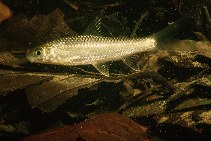
Rayons mous dorsaux (Total) : 11; Rayons mous anaux: 8. Differs from congeners from Java, Sumatra and Borneo by having the following unique combination of features: lateral line scales 30-31+3; absence of black blotch on end of caudal peduncle; absence of crescentric mark along posterior edge of scales; 2 barbels, less than eye diameter or absent; pectoral fin extending to or almost to the pelvic-fin origin; pelvic fin extending to anal-fin origin; dorsal-fin tip reaching behind vertical through anal-fin origin, when folded backwards; scale rows between lateral line and dorsal fin origin 5-6½; and curved sheath edge of lower jaw (Ref. 75626).
Body shape (shape guide): fusiform / normal.
Juveniles are common in shallow, fast flowing areas with gravel substrate (Ref. 34011).
Cycle de vie et comportement reproducteur
Maturité | Reproduction | Frai | Œufs | Fécondité | Larves
Kottelat, M. and H.H. Tan, 2008. A synopsis of the genus Lobocheilos in Java, Sumatra and Borneo, with descriptions of six new species (Teleostei: Cyprinidae). Ichthyol. Explor. Freshwat. 19(1):27-58. (Ref. 75626)
Statut dans la liste rouge de l'IUCN (Ref. 130435: Version 2025-2 (Global))
Menace pour l'homme
Harmless
Utilisations par l'homme
Outils
Articles particuliers
Télécharger en XML
Sources Internet
Estimations basées sur des modèles
Indice de diversité phylogénétique (Réf.
82804): PD
50 = 0.5000 [Uniqueness, from 0.5 = low to 2.0 = high].
Bayesian length-weight: a=0.01000 (0.00549 - 0.01823), b=3.07 (2.92 - 3.22), in cm total length, based on LWR estimates for this species & (Sub)family-body (Ref.
93245).
Résilience (Réf.
120179): Milieu, temps minimum de doublement de population : 1,4 à 4,4 années (K=0.3).
Vulnérabilité de la pêche (Ref.
59153): Low to moderate vulnerability (30 of 100).
🛈