>
Eupercaria/misc (Various families in series Eupercaria) >
Sparidae (Porgies)
Etymology: Diplodus: Greek, diploos = twice + Greek, odous = teeth (Ref. 45335).
Milieu: milieu / Klimaatzone / Diepte / verspreidingsgebied
Ecologie
marien benthopelagisch; oceanodroom (Ref. 51243); diepte 0 - 160 m, usually 0 - 30 m (Ref. 13780). Subtropical; ? - 25°C (Ref. 130592); 50°N - 40°S, 26°W - 36°E
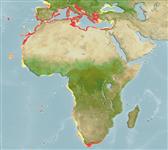
Eastern Atlantic: Bay of Biscay to Cape Verde and the Canary Islands including the Mediterranean and Black Sea (off Bulgaria); also from Angola to South Africa.
Lengte bij maturiteit / Grootte / Gewicht / Leeftijd
Maturiteit: Lm 16.6 range ? - ? cm
Max length : 45.0 cm TL mannelijk / geslacht onbekend; (Ref. 3397); common length : 22.0 cm TL mannelijk / geslacht onbekend; (Ref. 3397); max. gepubliceerd gewicht: 1.3 kg (Ref. 40637)
A euryhaline species inhabiting rocky and sometimes sandy bottoms to depths of 160 m, but more commonly in less than 50 m. The young are sometimes found in seagrass beds. Adults feed on crustaceans, worms and mollusks (Ref. 3688). Important food fish.
Potentially hermaphroditic (Ref. 4781).
Bauchot, M.-L. and J.-C. Hureau, 1990. Sparidae. p. 790-812. In J.C. Quero, J.C. Hureau, C. Karrer, A. Post and L. Saldanha (eds.) Check-list of the fishes of the eastern tropical Atlantic (CLOFETA). JNICT, Lisbon; SEI, Paris; and UNESCO, Paris. Vol. 2. (Ref. 3688)
Status op de Rode Lijst van het IUCN (Ref. 130435: Version 2025-2 (Global))
Gevaar voor de mens
Harmless
Gebruik door de mens
Visserij: commercieel; sportvis: ja; Aquarium: Commercieel
Tools
Speciale rapporten
Download XML
Internetbronnen
Schattingen op basis van modellen
Gewenste temperatuur (Ref.
123201): 15.9 - 21.6, mean 18.8 °C (based on 248 cells).
Fylogenetische diversiteitsindex (Ref.
82804): PD
50 = 0.5000 [Uniqueness, from 0.5 = low to 2.0 = high].
Bayesian length-weight: a=0.01230 (0.01099 - 0.01378), b=3.05 (3.03 - 3.07), in cm total length, based on LWR estimates for this species (Ref.
93245).
Trofisch niveau (Ref.
69278): 3.5 ±0.1 se; based on diet studies.
Generation time: 4.3 (2.8 - 5.5) years. Estimated as median ln(3)/K based on 16
growth studies.
Weerstandsvermogen (Ref.
120179): Gemiddeld, minimale populatieverdubbelingstijd 1,4-4,4 jaar (K=0.26-0.4; tmax=6; tm=2).
Kwetsbaarheid van de visserij (Ref.
59153): Low to moderate vulnerability (33 of 100).
🛈
Kwetsbaarheid voor het klimaat (Ref.
125649): Low vulnerability (23 of 100).
🛈
Voedingsstoffen (Ref.
124155): Calcium = 49.2 [25.2, 92.2] mg/100g; Iron = 0.766 [0.416, 1.387] mg/100g; Protein = 18.8 [17.8, 19.7] %; Omega3 = 0.345 [0.189, 0.641] g/100g; Selenium = 29.6 [13.1, 62.5] μg/100g; VitaminA = 24.3 [6.3, 92.6] μg/100g; Zinc = 0.919 [0.627, 1.322] mg/100g (wet weight); based on
nutrient studies.