>
Syngnathiformes (Pipefishes and seahorses) >
Syngnathidae (Pipefishes and seahorses) > Syngnathinae
Etymology: Syngnathus: Greek, syn, symphysis = grown together + Greek, gnathos = jaw (Ref. 45335).
More on author: Linnaeus.
สิ่งแวดล้อม : สิ่งแวดล้อม / เขตภูมิอากาศ / ระดับความลึก / ระยะการกระจายสินค้า
นิเวศวิทยา
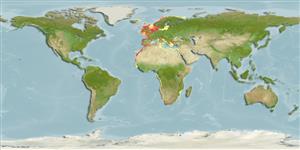
เกี่ยวกับทะเล,น้ำเค็ม; กร่อย สัตว์น้ำหน้าดิน; ไม่มีการอพยพย้ายถิ่น (Ref. 88171); ระดับความลึก 0 - 110 m (Ref. 4281), usually 3 - 15 m (Ref. 126547). Subtropical; 71°N - 35°S, 19°W - 42°E
Eastern Atlantic: Norway, Faroes and British Isles to Western Sahara, Senegambia, and from Namibia to Cape of Good Hope and northward to the coast of Zululand in the western Indian Ocean (Ref. 4127). Also throughout the Mediterranean, Aegean and Black seas. Despite literature records, occurrence in the Indo-Pacific outside South African waters lacks conclusive evidence (Ref. 4281).
ความยาวเมื่อครบกำหนดครั้งแรก / ขนาด / น้ำหนัก / อายุ
วัยเจริญพันธุ์: Lm 16.3, range 7 - 25.6 cm
Max length : 50.0 cm TL เพศผู้/กระเทย; (Ref. 35388)
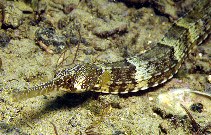
เงี่ยงครีบหลัง (รวม) : 0; ก้านครีบอ่อนที่หาง (รวม) : 33 - 42; เงี่ยงครีบก้น: 0; ก้านครีบอ่อนที่ก้น: 3. Light greenish to dark brown in color with variable markings (Ref. 4281). Snout cylindrical, equal to or less than eye diameter. With 18 - 19 body rings between head and dorsal fin (Ref. 35388). The snake pipefish (Entelurus aequoreus) is distinguished by the lack of pectoral and anal fins (Ref. 88171). An elongated bump on top of head behind eye (Ref. 59043).
Body shape (shape guide): eel-like.
Found in coastal and estuarine waters to depths of at least 110 m (Ref. 4281); on sand, mud and rough bottoms. Common amongst algae and eel-grass (Zostera) (Refs. 4146, 6733, 88187). Feeds mainly on small crustaceans (Ref. 85544). It is parasitised by the monogenean Gyrodactylus eyipayipi on the body surface, inside the flute and male brood pouch (Ref. 124059).
Ovoviviparous; reproducing on average 3 times each year (Ref. 89328). Several females depositing partial clutches to a male’s brood pouch under the tail (Refs. 205, 31201). Up to 400 eggs may be found in a single pouch (Ref. 89329). Brooding males occur mainly between May and July (Refs. 31201, 58137). During the breeding season, both males and females were observed to remain low amongst the seagrass in one meadow (Ref. 31201). Gestation period lasts about 5 weeks and size at birth is 1.7- 3.5 cm (Refs. 58137, 88187, 89330). Aquarium experiments have shown that new born young are benthic, remaining close to the bottom Ref. 89330).
Dawson, C.E., 1986. Syngnathidae. p. 628-639. In P.J.P. Whitehead, M.-L. Bauchot, J.-C. Hureau, J. Nielsen and E. Tortonese (eds.) Fishes of the North-eastern Atlantic and the Mediterranean. Volume 2. Unesco, Paris. (Ref. 6733)
สถานะบัญชีแดงของ IUCN (Ref. 130435: Version 2025-2 (Global))
ภัยคุกคามต่อมนุษย์
Harmless
การใช้ของมนุษย์
การประมง: ไม่มีผลประโยชน์; สถานที่แสดงสัตว์และพืชน้ำ: การค้า
เครื่องมือ
รายงานพิเศษ
ดาวน์โหลด XML
แหล่งที่มาจากอินเตอร์เน็ต
การประมาณค่าตามแบบจำลอง
อุณหภูมิที่ต้องการ (อ้างอิง
123201): 10.3 - 22.6, mean 17.7 °C (based on 934 cells).
ดัชนีความหลากหลายทางวิวัฒนาการ (อ้างอิง
82804): PD
50 = 0.5000 [Uniqueness, from 0.5 = low to 2.0 = high].
Bayesian length-weight: a=0.00025 (0.00019 - 0.00032), b=3.22 (3.16 - 3.28), in cm total length, based on LWR estimates for this species (Ref.
93245).
ระดับชั้นอาหาร (อ้างอิง
69278): 3.3 ±0.2 se; based on diet studies.
ความสามารถในการกลับคืนสู่ปกติ (อ้างอิง
120179): ขนาดกลาง, เวลาต่ำสุดที่จะทำให้ประชากรเพิ่มขึ้นเป็น 2 เท่าใช้เวลา 1.4 - 4.4 ปี (Fec=200).
ความเสี่ยงต่อการตกปลา (Ref.
59153): Moderate vulnerability (40 of 100).
🛈
สารอาหาร (Ref.
124155): Calcium = 54.6 [12.4, 151.7] mg/100g; Iron = 1.02 [0.39, 3.52] mg/100g; Protein = 3.7 [0.1, 7.5] %; Omega3 = 0.286 [0.130, 0.629] g/100g; Selenium = 22.8 [5.1, 60.3] μg/100g; VitaminA = 9.35 [4.02, 21.44] μg/100g; Zinc = 0.838 [0.431, 1.605] mg/100g (wet weight);