>
Syngnathiformes (Pipefishes and seahorses) >
Syngnathidae (Pipefishes and seahorses) > Syngnathinae
Etymology: Hippocampus: Greek, ippos = horse + Greek,kampe = curvature (Ref. 45335).
More on author: Cuvier.
Milieu: milieu / Klimaatzone / Diepte / verspreidingsgebied
Ecologie
marien; brak water demersaal; standvastig; diepte 0 - 30 m (Ref. 128812). Temperate; 63°N - 20°N, 32°W - 36°E
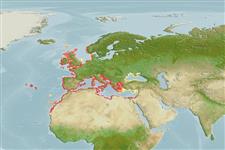
Eastern Atlantic: British Isles and the Netherlands to Morocco, Canary Islands (Ref. 4509), Madeira, and the Azores, including the Mediterranean (Ref. 89253) and the Black Sea (Ref. 89255).
Lengte bij maturiteit / Grootte / Gewicht / Leeftijd
Maturiteit: Lm 12.5 range ? - ? cm
Max length : 21.5 cm SL mannelijk / geslacht onbekend; (Ref. 79902); 18.0 cm OT (female)
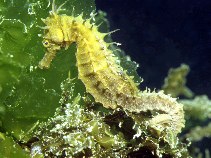
Dorsale stekels (totaal) : 0; Dorsale zachte stralen (totaal) : 17 - 20. Description (based on 46 specimens): Adult height: 8.5-18.0cm. Rings: 11 + 37-39 (35-40). Snout length: 2.3-2.8 in head length. Dorsal fin rays: 19-20 (17-20) covering 2+1 rings. Pectoral fin rays: 16-18. Coronet: small but distinct, with 5 rounded knobs or blunt points; horizontal plate in front of coronet as high as coronet itself, with a more or less prominent spine at its front edge; coronet not joined smoothly to neck. Spines: medium to well-developed with blunt tips. Other distinctive characters: prominent rounded eye spines; often with a mane of thick skin fronds on neck and head. Color pattern: from dark green to brown (Refs. 52034, 89230); prominent white spots on body (often with a dark ring around them) which tend to coalesce into horizontal wavy lines103; may be variously mottled or with pale ‘saddles’ across dorsolateral surface.
Body shape (shape guide): other.
Commonly referred to as Hippocampus ramulosus. Occurs mostly in shallow inshore waters including littoral lagoons (Ref. 9937) among algae and eel grass (Zostera or Posidonia), or among rocks and in gravel bottoms (Ref. 52034). Juveniles were observed to recruit to vegetated habitats at 8.8- 10.4 cm length (Ref. 79902). Adults (from 12.5 cm length) appear to maintain very restricted home ranges (19.9 ± 12.4 m2) over multiple years making limited daily movements. (Ref. 79902). May move to deeper waters during winter (Ref. 53712). Like other seahorse species, adult dispersals over large distances is probably caused by strong wave action and currents during storms or when it anchors itself to floating debris (Ref. 52034). Is thought to live for 4-7 years (Ref. 79902). Because of its early age at maturity, rapid growth rate, short generation time and multiple breeding cycles during each spawning season, resilience is thought to be high (Ref. 88171). However, in tropical areas where seagrass beds are regularly exploited for other species of seahorses for the aquarium trade, traditional medicine, etc., populations have been quickly eradicated (Ref. 89253). Can be maintained in an aquarium environment if trained to feed on dead animals (Ref. 88171). Length type OT refers to height (= TL - head length), Ref. 30915.
Ovoviviparous. During the mating season, mature males and females have been observed to change hue, i.e., become brighter, when courting (Refs. 52034, 89259). Female deposits her eggs on the brood pouch of the male which is found under the tail (Ref. 205). Gestation usually lasts 21 days (Ref. 89322) and brood sizes up to 581 have been reported (Refs. 53712, 79902, 89322). Young are expelled from the pouch measuring 1.5 cm after 3 weeks of incubation. Size at birth ranges from 0.6-1.4 cm length (Ref. 79902). Newly hatched young are planktonic for at least 8 weeks (Ref. 53712).
Lourie, S.A., R.A. Pollom and S.J. Foster, 2016. A global revision of the seahorses Hippocampus Rafinesque 1810 (Actinopterygii: Syngnathiformes): taxonomy and biogeography with recommendations for further research. Zootaxa 4146(1):1-66. (Ref. 115213)
Status op de Rode Lijst van het IUCN (Ref. 130435: Version 2025-2 (Global))
Gevaar voor de mens
Harmless
Gebruik door de mens
Visserij: van minder commercieel belang; Aquarium: Commercieel
Tools
Speciale rapporten
Download XML
Internetbronnen
Schattingen op basis van modellen
Gewenste temperatuur (Ref.
123201): 12.3 - 21, mean 18.6 °C (based on 619 cells).
Fylogenetische diversiteitsindex (Ref.
82804): PD
50 = 0.5000 [Uniqueness, from 0.5 = low to 2.0 = high].
Bayesian length-weight: a=0.00316 (0.00183 - 0.00546), b=2.93 (2.77 - 3.09), in cm total length, based on LWR estimates for this species & (Sub)family-body (Ref.
93245).
Trofisch niveau (Ref.
69278): 3.5 ±0.4 se; based on diet studies.
Generation time: 1.9 ( na - na) years. Estimated as median ln(3)/K based on 1
growth studies.
Weerstandsvermogen (Ref.
120179): Gemiddeld, minimale populatieverdubbelingstijd 1,4-4,4 jaar (Fec=581).
Kwetsbaarheid van de visserij (Ref.
59153): Low vulnerability (24 of 100).
🛈
Voedingsstoffen (Ref.
124155): Calcium = 49.7 [10.3, 150.8] mg/100g; Iron = 0.442 [0.173, 1.344] mg/100g; Protein = 3.26 [0.00, 7.03] %; Omega3 = 0.478 [0.213, 1.148] g/100g; Selenium = 6.31 [1.02, 18.72] μg/100g; VitaminA = 16.6 [5.7, 47.2] μg/100g; Zinc = 0.803 [0.391, 1.518] mg/100g (wet weight);