>
Eupercaria/misc (Various families in series Eupercaria) >
Lethrinidae (Emperors or scavengers) > Monotaxinae
Etymology: Gymnocranius: Greek, gymnos = naked + Greek, kranion = skull (Ref. 45335).
Eponymy: Audley Raymond Jones was a friend of the author and an amateur ichthyologist. Ogilby wrote: “…Named after my friend Audley Raymond Jones, to whom I am indebted for much interesting information regarding the habits of our fishes.” (Ref. 128868), visit book page.
More on author: Ogilby.
Umwelt: Milieu / Klimazone / Tiefenbereich / Verbreitungsgebiet
Ökologie
seewasser riff-verbunden; standorttreu; tiefenbereich 8 - 40 m (Ref. 2295). Subtropical; 15°S - 25°S
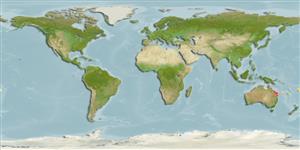
Western Pacific: Australia (east coast of southern Queensland and the southern half of the Great Barrier Reef). The name bitorquatus has been applied to this species, particularly by Australian authors.
Größe / Gewicht / Alter
Geschlechtsreife: Lm ? range ? - ? cm
Max length : 40.0 cm TL Männchen/unbestimmt; (Ref. 2295); common length : 35.0 cm TL Männchen/unbestimmt; (Ref. 2295)
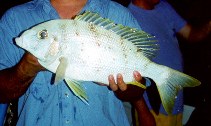
Rückenflossenstacheln (insgesamt) : 10; Rückenflossenweichstrahlen (insgesamt) : 10; Afterflossenstacheln: 3; Afterflossenweichstrahlen: 9 - 10. Inner surface of pectoral fin without scales. Overall color is silver or whitish, often light brown or olive on upper sides. Each scale on sides has a brown spot forming longitudinal rows. Fins are uniformly clear to slightly yellowish. Fresh specimen have scattered brown flecks on sides. A blackish bar that runs through the eye may also be evident.
Body shape (shape guide): fusiform / normal; Cross section: oval.
Generally solitary over sand or rubble areas adjacent to reefs . Feeds mainly on benthic invertebrates. Sometimes has a distasteful iodine flavor; however, untainted fish are good to eat.
Lebenszyklus und Paarungsverhalten
Geschlechtsreife | Fortpflanzung | Ablaichen | Eier | Fruchtbarkeit | Larven
Carpenter, K.E. and G.R. Allen, 1989. FAO Species Catalogue. Vol. 9. Emperor fishes and large-eye breams of the world (family Lethrinidae). An annotated and illustrated catalogue of lethrinid species known to date. FAO Fish. Synop. 125(9):118 p. Rome: FAO. (Ref. 2295)
IUCN Rote Liste Status (Ref. 130435: Version 2025-2 (Global))
Bedrohung für Menschen
Harmless
Nutzung durch Menschen
Fischereien: weniger kommerziell; Sportfisch: ja
Tools
Zusatzinformationen
Download XML
Internet Quellen
Schätzungen auf der Grundlage von Modellen
Bevorzugte Temperatur (Ref.
123201): 24.5 - 27, mean 26.1 °C (based on 58 cells).
Phylogenetischer Diversitätsindex (Ref.
82804): PD
50 = 0.5005 [Uniqueness, from 0.5 = low to 2.0 = high].
Bayesian length-weight: a=0.02089 (0.01052 - 0.04149), b=2.99 (2.82 - 3.16), in cm total length, based on LWR estimates for this species & (Sub)family-body (Ref.
93245).
Trophische Ebene (Ref.
69278): 3.4 ±0.41 se; based on food items.
Generation time: 4.8 ( na - na) years. Estimated as median ln(3)/K based on 2
growth studies.
Widerstandsfähigkeit (Ref.
120179): mittel, Verdopplung der Population dauert 1,4 - 4,4 Jahre. (K=0.56; tmax=13).
Anfälligkeit der Fischerei (Ref.
59153): Low to moderate vulnerability (26 of 100).
🛈
Nährstoffe (Ref.
124155): Calcium = 28.7 [13.7, 71.1] mg/100g; Iron = 0.587 [0.296, 1.075] mg/100g; Protein = 20.3 [18.3, 22.3] %; Omega3 = 0.191 [0.099, 0.318] g/100g; Selenium = 15.9 [7.9, 32.8] μg/100g; VitaminA = 32.9 [9.2, 106.3] μg/100g; Zinc = 0.795 [0.525, 1.209] mg/100g (wet weight);