分類 / 名前
共通名の | 類義語 | Catalog of Fishes(部類, 種) | ITIS | CoL | WoRMS | Cloffa
>
Eupercaria/misc (Various families in series Eupercaria) >
Lethrinidae (Emperors or scavengers) > Lethrininae
Etymology: Lethrinus: Greek, lethrinia, a fish pertaining to genus Pagellus.
More on author: Forsskål.
環境:環境 / 気候帯 / 深さの範囲 / 分布範囲
生態学
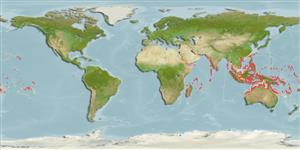
海 関連する礁; 移住性ではない; 深さの範囲 ? - 30 m (Ref. 2295). Tropical; 27°N - 26°S, 33°E - 138°W
Indo-Pacific: Red Sea and East Africa to the Ryukyu Islands and east to French Polynesia.
初回成熟時の長さ / サイズ / 重さ / 年齢
成熟: Lm 23.7 range ? - 25.7 cm
Max length : 60.0 cm TL オス/雌雄の選別がない; (Ref. 30573); common length : 30.0 cm TL オス/雌雄の選別がない; (Ref. 30573); 最大記録サイズ: 14 年 (Ref. 2295)
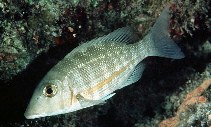
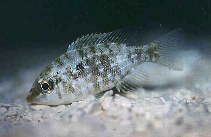
背面の脊椎 (合計) : 10; 背鰭 (合計) : 9; 肛門の骨: 3; 臀鰭: 8. The body is light tan or olive to brown, becoming lighter below. the centers of the scales are often lighter than the background color. The head, often, has several broad indistinct vertical and diagonal light and dark bands. Sometimes there are white spots below the eye. The posterior edge of the operculum is dark brown. An orange-yellow stripe is on the lower part of the side with two additional more faint orange-yellow stripes above and one below this stripe. The fins are whitish or tan, sometimes mottled.
Body shape (shape guide): fusiform / normal; Cross section: oval.
Found over seagrass beds (Ref. 41878), sand and rubble areas of lagoons and reefs (Ref. 30573). Found singly or in groups (Ref. 9710). Juveniles on weedy reefs (Ref. 48635). Feed on mollusks, crustaceans, and echinoderms (Ref. 30573). One of the commonest lethrinids along the coast of east Africa (Ref. 4369). Marketed fresh (Ref. 9775).
ライフサイクルと交尾行動
成熟 | 繁殖 | 放精 | 卵 | 生産力 | 幼生
Gonochorism is inferred for this species as sizes of males and females overlapped and male gonad morphology is typical of secondarily derived testes (Ref. 103751). This may be supported further by the study of Ebisawa etal (2006) which characterised sexual pattern for this species as juvenile hermaphroditism indicating that sexual transition occurred before ovarian maturation, a case for non-functional hermaphroditism in Ref. 103751.
Carpenter, K.E. and G.R. Allen, 1989. FAO Species Catalogue. Vol. 9. Emperor fishes and large-eye breams of the world (family Lethrinidae). An annotated and illustrated catalogue of lethrinid species known to date. FAO Fish. Synop. 125(9):118 p. Rome: FAO. (Ref. 2295)
IUCNのレッドリストの状況は (Ref. 130435: Version 2025-2 (Global))
人間の用途
水産業: 少数商業の
用具
特記事項
XMLをダウンロードして下さい
インターネットの情報源
モデルに基づく推定値
好ましい温度 (参照
123201): 26.1 - 29.3, mean 28.5 °C (based on 3253 cells).
系統多様性指数 (参照
82804): PD
50 = 0.5000 [Uniqueness, from 0.5 = low to 2.0 = high].
Bayesian length-weight: a=0.01148 (0.00759 - 0.01738), b=2.98 (2.86 - 3.10), in cm total length, based on LWR estimates for this species & Genus-body shape (Ref.
93245).
栄養段階 (参照
69278): 3.9 ±0.2 se; based on diet studies.
Generation time: 2.9 ( na - na) years. Estimated as median ln(3)/K based on 1
growth studies.
回復力 (参照
120179): 低い, 4.5年~14年の倍増期間の最小個体群 (tmax=14).
漁業の脆弱性 (Ref.
59153): Low to moderate vulnerability (33 of 100).
🛈
気候脆弱性 (Ref.
125649): Very high vulnerability (83 of 100).
🛈
栄養素 (Ref.
124155): Calcium = 41.4 [28.5, 59.9] mg/100g; Iron = 0.828 [0.549, 1.177] mg/100g; Protein = 20.4 [17.8, 22.6] %; Omega3 = 0.122 [0.087, 0.170] g/100g; Selenium = 39.8 [21.9, 64.1] μg/100g; VitaminA = 25.8 [5.6, 137.3] μg/100g; Zinc = 1.91 [1.44, 2.47] mg/100g (wet weight);