分类 / 名称
俗名 | 同种异名 | Catalog of Fishes(属, 种) | ITIS | CoL | WoRMS | Cloffa
Teleostei >
Eupercaria/misc (Various families in series Eupercaria) >
Lethrinidae (Emperors or scavengers) > Lethrininae
Etymology: Lethrinus: Greek, lethrinia, a fish pertaining to genus Pagellus.
环境:氛围 / 气候带 / 深度上下限 / 分布范围
生态学
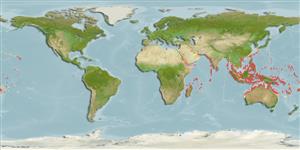
海洋; 半咸淡水 礁区鱼类; 非迁移的; 深度上下限 0 - 20 m (Ref. 9710). 热带; 32°N - 32°S, 31°E - 155°W
Indo-West Pacific: Red Sea and E ast Africa to Samoa, north to southern Japan, south to northeastern Australia.
印度-西太平洋: 红海而且东非到美属萨摩亚, 北至日本南部, 南至澳洲东北方。
首次成熟时的长度 / 大小 / 重量 / 年龄
成熟度: Lm 19.5 range ? - 21.1 cm
Max length : 54.9 cm FL 雄鱼/尚未辨别雌雄; (Ref. 125599); common length : 30.0 cm TL 雄鱼/尚未辨别雌雄; (Ref. 30573); 最大体重: 2.9 kg (Ref. 125599); 最大年龄: 15 年 (Ref. 2293)
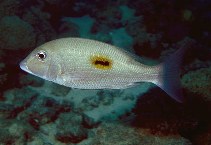
背棘 (总数) : 10; 背的软条 (总数) : 9; 臀棘: 3; 臀鳍软条: 8. This species is distinguished by the following characters: body moderately deep, its depth 2.6-2.8 times in standard length; head length 0.9-1 times in body depth, 2.7-3.1 times in SL length, dorsal profile near eye distinctly or slightly convex; snout short and blunt, its length about 2.0-2.6 times in HL, measured without the lip the snout is 0.9-1 times in cheek height, its dorsal profile nearly straight, snout angle relative to upper jaw between 60° and 70°; interorbital space convex or almost flat; posterior nostril a narrow longitudinal slit, closer to orbit than anterior nostril; eye situated close to dorsal profile, its length 3.4-4.2 times in HL; cheek not very high, its height 2.3-3.1 times in HL; lateral teeth in jaws of adults molars or rounded; outer surface of maxilla smooth or with a longitudinal ridge; D X,9 the 4th or 5th dorsal-fin spine the longest, its length 2.5-3.1 times in body depth; A III,8 with the first soft ray usually the longest, its length almost equal to or longer or shorter than length of base of soft-rayed portion of anal fin and 1.2-1.6 times in length of entire anal-fin base; pectoral-fin rays 13; pelvic-fin membranes between rays closest to body without dense melanophores; cheek without scales; 46-47 lateral-line scales usually; usually 5 ½ (sometimes 4 ½) scale rows between lateral line and base of middle dorsal-fin spines; 14-16 scale rows in transverse series between origin of anal fin and lateral line; 13-14 rows in lower series of scales around caudal peduncle; 4-8 scales in supratemporal patch; inner surface of pectoral-fin base densely covered with scales; posterior angle of operculum fully scaly. Colour of body olive or grey above, shading to silvery white below; a large elliptical black spot, often broadly edged in yellow, on side directly below lateral line and centered at a vertical near the posterior tip of pectoral fins; sometimes light blue dots bordering lower rim of eye and around nostrils; pectoral, pelvic, dorsal, and anal fins white to pinkish; caudal fin orange or reddish; vertical fins sometimes lightly mottled or striped (Ref. 114226).
Body shape (shape guide): fusiform / normal; Cross section: oval.
嘴些微可伸出; 唇厚而肉质的。 内部的胸鳍基底厚密地覆盖着鳞片了。 色彩是橄榄绿色的背面, 腹侧灰白的; 鳞片背面有时具有白色的中心。 一个大的椭圆斑块,时常宽广地边缘是黄色了, 在侧边上直接在侧线下而且在胸鳍的一个垂直近后面的顶端集中。 有时浅蓝色点毗邻眼的下面霜与鼻孔的周围。 胸鳍,腹鳍, 背鳍与臀鳍是白色到略带桃色的。 尾鳍是橘色或淡红的。 垂直的鳍有时是有淡色的斑点或斑纹。
Found solitary or in small schools over shallow sandy, coral rubble, mangroves, lagoons, channel and seagrass areas inshore and adjacent to coral reefs. Feeds on polychaetes, crustaceans, mollusks, echinoderms and small fish. Reported to spawn throughout the year during the first five days of the lunar month in large aggregations in Palau. Caught mostly by shore seine, gill nets, traps, and handline. Marketed mostly fresh (Ref. 171, 68703); flesh spoils rapidly (Ref. 4369).
单独发现或者形成小群鱼群于水浅的沙地,珊瑚残砾,红树林,泻湖,峡道与海草区域沿海地区与邻近珊瑚礁。 吃多毛类动物,甲壳动物,软件动物,棘皮动物与小鱼。 报告的在帛琉较大时在第一个的时候产卵全年度五天的阴历月群集。 在市场上销售生鲜地了 (参考文献 171; 肉很快地腐败。 (参考文献 4369)
生命周期和交配行为
成熟度 | 繁殖 | 产卵场 | 卵 | 孕卵数 | 仔鱼
印度-西太平洋: 红海而且东非到美属萨摩亚, 北至日本南部, 南至澳洲东北方。
Carpenter, K.E. and G.R. Allen, 1989. FAO Species Catalogue. Vol. 9. Emperor fishes and large-eye breams of the world (family Lethrinidae). An annotated and illustrated catalogue of lethrinid species known to date. FAO Fish. Synop. 125(9):118 p. Rome: FAO. (Ref. 2295)
世界自然保护联盟红皮书 (Ref. 130435: Version 2025-2 (Global))
人类利用
渔业: 商业性
工具
特别资料
下载 XML
网络资源
基于模型的估算
首选温度 (参考文献
123201): 25.7 - 29.2, mean 28.5 °C (based on 3040 cells).
系统发育多样性指数 (参考文献
82804): PD
50 = 0.5000 [Uniqueness, from 0.5 = low to 2.0 = high].
Bayesian length-weight: a=0.01445 (0.01215 - 0.01720), b=2.98 (2.94 - 3.02), in cm total length, based on LWR estimates for this species (Ref.
93245).
营养阶层 (参考文献
69278): 3.6 ±0.5 se; based on diet studies.
回复力 (参考文献
120179): 中等的, 族群倍增时间最少 1.4 - 4.4年 (K=0.45-0.49; tmax=15).
Prior r = 0.58, 95% CL = 0.38 - 0.87, Based on 1 data-limited stock assessment.
渔业脆弱性 (Ref.
59153): Low to moderate vulnerability (31 of 100).
🛈
气候脆弱性 (Ref.
125649): Very high vulnerability (79 of 100).
🛈
营养素 (Ref.
124155): Calcium = 49.7 [34.2, 75.8] mg/100g; Iron = 0.885 [0.562, 1.363] mg/100g; Protein = 20.5 [18.0, 22.8] %; Omega3 = 0.128 [0.087, 0.187] g/100g; Selenium = 34.2 [20.1, 62.6] μg/100g; VitaminA = 24.1 [4.9, 137.6] μg/100g; Zinc = 2.54 [1.84, 3.36] mg/100g (wet weight);