>
Eupercaria/misc (Various families in series Eupercaria) >
Lethrinidae (Emperors or scavengers) > Lethrininae
Etymology: Lethrinus: Greek, lethrinia, a fish pertaining to genus Pagellus.
More on author: Forster.
محیط زیست: محیط زیست / منطقه آب و هوایی / تغييرات عمق / محدوده توزیع
بوم شناسي
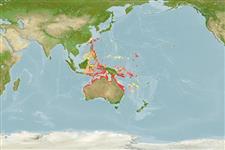
دريايي; لب شور وابسته به آب سنگ; غير مهاجر; تغييرات عمق 5 - 30 m (Ref. 2295). Tropical; 27°N - 34°S, 113°E - 168°E
Western Pacific: The Ryukyu Islands, eastern Philippines, northern Australia, and New
Caledonia (Ref. 114226). Occurrence records outside distributional range probably refer to Lethrinus olivaceus (Ref. 2295).
طول در اولین بلوغ / اندازه / وزن / سن
بلوغ: Lm 36.1 range ? - 42.2 cm
Max length : 90.0 cm TL جنس نر / بدون خواص جنسي; (Ref. 2295); common length : 40.0 cm TL جنس نر / بدون خواص جنسي; (Ref. 9987); بيشينه وزن گزارش شده: 9.6 kg (Ref. 9987); بيشينه سن گزارش شده: 22 سال ها (Ref. 2290)
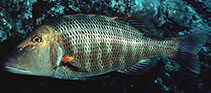
خارهاي باله پشتي (کل) : 10; شعاع نرم باله پشتي (کل) : 9; خارهاي باله مخرجي: 3; شعاع نرم باله مخرجي: 8. This species is distinguished by the following characters: body moderately deep, its depth 2.4-2.8 times in standard length; head length 0.9-1 times in body depth, 2.5-2.9 times in SL, dorsal profile near eye slightly convex; snout moderately long, its length about 1.7-2.4 times in HL, measured without the lip the snout is 0.9-1 times in cheek height, its dorsal profile slightly concave, snout angle relative to upper jaw between 50° and 65°; interorbital space convex to flat; posterior nostril an oblong longitudinal opening, closer to orbit than anterior nostril; eye situated close to dorsal profile, its length 3.4-5.4 times in HL; cheek moderately high, its height 2.0-2.9 times in HL; lateral teeth in jaws conical; outer surface of maxilla smooth or with a longitudinal ridge; D X,9 with the 3rd dorsal-fin spine usually longest, its length 2.3-2.9 times in body depth; A III,8 with the 1st or 2nd soft ray usually the longest, its length almost equal to or slightly longer than length of base of soft-rayed portion of anal fin and 1.3-1.4 times in length of entire anal-fin base; pectoral-fin rays 13; pelvic-fin membranes between rays closest to body usually with dense melanophores; no scales on cheek; 46-48 lateral-line scales; 4½ scale rows between lateral line and base of middle dorsal-fin spines; 15 to 17 scale rows in transverse series between origin of anal fin and lateral line; usually 15 rows in lower series of scales around caudal peduncle; 2-7 scales in supratemporal patch; inner surface of pectoral fins partially or densely covered with scales; posterior angle of operculum fully scaly. Colour of body silvery, tan, or yellowish, base of scales often black, often a series of 8-9 dark bars (may be absent in some individuals); base of pectoral fins red; sometimes a red streak originating on upper operculum, passing beneath eye and onto snout; 2 red spots often on upper rim of eye; lips reddish; fins pale or reddish, sometimes brilliant red on membranes near base of pelvic fins, and between spinous rays of dorsal and anal fin (Ref 68703).
Body shape (shape guide): fusiform / normal; Cross section: oval.
Adults inhabit coral reefs during daytime where they feed occasionally in sand and rubble areas between coral heads. At night, they move out over the sandy sea floor and forage actively. Usually occur in small schools. Juveniles live in shallow, inshore waters such as seagrass and mangrove areas, moving into deeper water as they age (Ref. 27260, 28202). Feed mainly on crustaceans, echinoderms, mollusks and fish, with crabs and sea urchins predominating. Much of the information reported for this species was based on misidentifications and referred to L. olivaceous (see Ref. 2295). Marketed fresh or frozen (Ref. 9987). Caught primarily by handline. One of the favourite food and sport fishes around the Great Barrier Reef. A major food fish in New Caledonia. Occasionally implicated in cases of fish poisoning (ciguatoxin) (Ref. 68703).
چرخه زندگی و رفتار جفتگیری
بلوغ | تولید مثل | تخم ریزی | تخم ها | باروری | توزاد ( لارو)
L. miniatus are serial hermaphrodites with a protogynous strategy (i.e, female first, male second). Sexual bimodality was present in both age and length frequency distributions (Brown et al 1994).
Juveniles live in shallow, inshore waters such as seagrass and mangrove areas, moving into deeper water as they age (Ref. 27260, 28202). Also Ref. 103751.
Carpenter, K.E. and G.R. Allen, 1989. FAO Species Catalogue. Vol. 9. Emperor fishes and large-eye breams of the world (family Lethrinidae). An annotated and illustrated catalogue of lethrinid species known to date. FAO Fish. Synop. 125(9):118 p. Rome: FAO. (Ref. 2295)
وضعيت در فهرست قرمز IUCN (Ref. 130435: Version 2025-2 (Global))
خطر برای انسان ها
Reports of ciguatera poisoning (Ref. 4690)
استفاده انسانی
ماهي گيري – شيلات: ارزش تحاري اندك; ماهي ها ي سرگرم كننده: بله
ابزارها
گزارش های ويژه
بارگيری XML
منابع اينترنتي
تخمینها بر اساس مدلها
دمای ترجیحی (مرجع
123201): 24.7 - 29.3, mean 28.4 °C (based on 1510 cells).
شاخص تنوع فیلوژنتیکی (مرجع
82804): PD
50 = 0.5000 [Uniqueness, from 0.5 = low to 2.0 = high].
Bayesian length-weight: a=0.01380 (0.00919 - 0.02074), b=3.00 (2.88 - 3.12), in cm total length, based on LWR estimates for this species & Genus-body shape (Ref.
93245).
سطح تروفیک (مرجع
69278): 4.2 ±0.0 se; based on diet studies.
Generation time: 4.2 (2.9 - 6.5) years. Estimated as median ln(3)/K based on 12
growth studies.
جهندگی (مرجع
120179): متوسط, كمينه زمان لازم براي دو برابر شدن جمعيت 4/1 – 4/4 سال (K=0.1-0.4; tm=2-3; tmax=22).
Prior r = 0.26, 95% CL = 0.17 - 0.39, Based on 1 full stock assessment.
آسیبپذیری ماهیگیری (Ref.
59153): Moderate vulnerability (41 of 100).
🛈
آسیبپذیری اقلیمی (Ref.
125649): Very high vulnerability (89 of 100).
🛈
مواد مغذی (Ref.
124155): Calcium = 30 [20, 49] mg/100g; Iron = 0.776 [0.487, 1.266] mg/100g; Protein = 20.6 [18.0, 22.9] %; Omega3 = 0.124 [0.082, 0.187] g/100g; Selenium = 38.3 [20.7, 69.4] μg/100g; VitaminA = 35.8 [7.8, 196.5] μg/100g; Zinc = 1.81 [1.24, 2.48] mg/100g (wet weight);