>
Eupercaria/misc (Various families in series Eupercaria) >
Lethrinidae (Emperors or scavengers) > Lethrininae
Etymology: Lethrinus: Greek, lethrinia, a fish pertaining to genus Pagellus.
More on author: Valenciennes.
Ambiente: milieu / zona climatica / distribuzione batimetrica / gamma di distribuzione
Ecologia
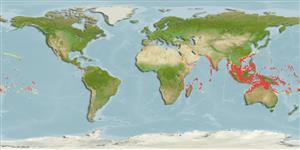
marino associati a barriera corallina; non migratori; distribuzione batimetrica 15 - 120 m (Ref. 9710). Tropical; 30°N - 23°S
Indo-Pacific: East Africa to the Society and Tuamoto islands, north to the Ryukyu Islands, south to northeastern Australia. The name Lethrinus kallopterus has long been applied to this species. Lethrinus cinnabarinus Richardson also appears to be synonymous with this species.
Lunghezza alla prima maturità / Dimensione / Peso / Età
Maturità: Lm ?, range 25 - ? cm
Max length : 70.0 cm TL maschio/sesso non determinato; (Ref. 2295); common length : 50.0 cm TL maschio/sesso non determinato; (Ref. 2295)
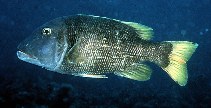
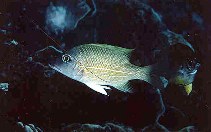
Spine dorsali (totale) : 10; Raggi dorsali molli (totale) : 9; Spine anali: 3; Raggi anali molli: 8. The largest species of Lethrinus distinguished by the following characters: body moderately deep, its depth 2.5-2.7 times in standard length (SL); head length 0.9-1 times in body depth, 2.5-2.8 times in SL; dorsal profile near eye nearly straight or slightly convex; snout moderately short, its length about 1.8-2.4 times in HL, measured without the lip the snout is 0.8-1.1 times in cheek height, its dorsal profile distinctly concave in large individuals and nearly straight in smaller individuals, snout angle relative to upper jaw between 55° and 69°; interorbital space convex; posterior nostril an oblong longitudinal opening, closer to orbit than anterior nostril; eye situated close to or far removed from dorsal profile, its length 2.7-5.2 times in HL; cheek moderately high, its height 2-3.4 times in HL; lateral teeth in jaws conical; outer surface of maxilla smooth or with a longitudinal ridge; D X,9 with 4th or 5th dorsal-fin spine the longest, its length 2.5-3.5 times in body depth; A III,8 with the 3rd, 4th or 5th soft ray usually the longest, its length much longer than length of base of soft-rayed portion of anal fin and 0.8-1.1 times in length of entire anal-fin base; pectoral-fin rays 13; pelvic-fin membranes between rays closest to body with or without dense melanophores; cheek without scales; 46-48 lateral-line scales; 4 ½ scale rows between lateral line and base of middle dorsal-fin spines; 15-18 scale rows in transverse series between origin of anal fin and lateral line; usually 15 rows in lower series of scales around caudal peduncle; 5-8 scales in supratemporal patch; inner surface of pectoral-fin base densely covered with scales; posterior angle of operculum fully scaly. Colour of body brown to dark grey, with indistinct scattered small dark and light spots, with irregular light stripes sometimes on lower sides; head brown or grey, often with many small orange spots on cheeks; pectoral and pelvic fins white to orangish, dorsal and anal fins mottled orange and bluish; caudal fin often bright orange (Ref. 114226).
Body shape (shape guide): fusiform / normal; Cross section: oval.
Occurs in deep lagoons and channels, outer reef slopes and adjacent soft bottom areas (Ref. 30573). Solitary in or near ledges or caves by day (Ref. 9710). Feeds on echinoderms, crustaceans, mollusks (Ref. 171), echinoids, crinoids and starfish (Ref. 37816). May be ciguatoxic in some areas (Ref. 37816). Caught by handline, vertical longline, traps, and trawls. Marketed mostly fresh (Ref. 171, 68703).
Ciclo vitale e comportamento di accoppiamento
Maturità | Riproduzione | Deposizione | Uova | Fecondità | Larve
Carpenter, K.E. and G.R. Allen, 1989. FAO Species Catalogue. Vol. 9. Emperor fishes and large-eye breams of the world (family Lethrinidae). An annotated and illustrated catalogue of lethrinid species known to date. FAO Fish. Synop. 125(9):118 p. Rome: FAO. (Ref. 2295)
Stato della Lista Rossa IUCN (Ref. 130435: Version 2025-2 (Global))
Minaccia per l'uomo
Reports of ciguatera poisoning (Ref. 2295)
Usi umani
Pesca: commerciale
Strumenti
Rapporti speciali
Scarica XML
Fonti Internet
Stime basate su modelli
Temperatura preferita (Fonte Biblio.
123201): 24.2 - 28.6, mean 27.5 °C (based on 748 cells).
Indice di diversità filogenetica (Fonte Biblio.
82804): PD
50 = 0.5000 [Uniqueness, from 0.5 = low to 2.0 = high].
Bayesian length-weight: a=0.01445 (0.00940 - 0.02222), b=3.02 (2.90 - 3.14), in cm total length, based on LWR estimates for this species & Genus-body shape (Ref.
93245).
Livello trofico (Fonte Biblio.
69278): 3.4 ±0.41 se; based on food items.
Generation time: 5.5 ( na - na) years. Estimated as median ln(3)/K based on 1
growth studies.
Resilienza (Fonte Biblio.
120179): Medio, tempo minimo di raddoppiamento della popolazione 1.4 - 4.4 anni (K=0.20).
Vulnerabilità della pesca (Ref.
59153): Moderate to high vulnerability (46 of 100).
🛈
Nutrienti (Ref.
124155): Calcium = 33 [24, 44] mg/100g; Iron = 0.756 [0.518, 1.051] mg/100g; Protein = 20 [17, 22] %; Omega3 = 0.124 [0.093, 0.166] g/100g; Selenium = 54.9 [30.5, 81.9] μg/100g; VitaminA = 25.5 [5.7, 130.8] μg/100g; Zinc = 2.03 [1.58, 2.51] mg/100g (wet weight);