>
Eupercaria/misc (Various families in series Eupercaria) >
Lethrinidae (Emperors or scavengers) > Monotaxinae
Etymology: Monotaxis: Greek, monos = one + Greek, taxis = disposition (Ref. 45335).
More on author: Forsskål.
Environnement : milieu / zone climatique / profondeur / gamme de distribution
Écologie
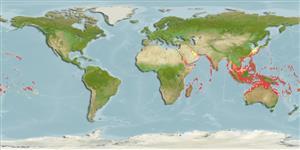
marin récifal; non migrateur; profondeur 0 - 100 m (Ref. 9710), usually 5 - 30 m (Ref. 9775). Tropical; 35°N - 30°S, 32°E - 122°W
Indo-Pacific: Red Sea and East Africa to the Hawaiian Islands and southeastern Oceania, north to Japan, south to Australia.
Longueur à la première maturité / Taille / Poids / Âge
Maturité: Lm 30.3, range 18 - ? cm
Max length : 60.0 cm TL mâle / non sexé; (Ref. 2295); common length : 40.0 cm TL mâle / non sexé; (Ref. 2295); poids max. publié: 5.9 kg (Ref. 40637)
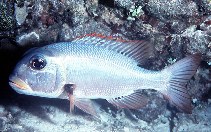
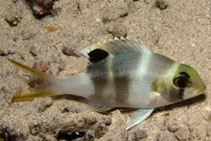
Épines dorsales (Total) : 10; Rayons mous dorsaux (Total) : 10; Épines anales: 3; Rayons mous anaux: 9. This species is distinguished by the following characters: body oblong, greatest body depth of adults about 2.2 in SL; head profile strongly convex in front of eye, the snout sloping steeply; eye large 2.7 (juveniles) to 3.8 (adults) in HL; inner surface of the pectoral fin base is densely scaled; pectoral rays usually 14; caudal fin forked with pointed tips; lateral line scales 44-47; scale rows above lateral line (to base of middle dorsal spines) 5, below (to origin of anal fin) 13.5; side of jaw with row of 5-7 molariform teeth. Color of adult silvery grey with narrow dark scale margins, lips yellowish, a large black blotch covering pectoral fin axil, quick to assume pattern of 4 broad, blackish bars on body, the pale interspaces covering 3-4 scale rows; juveniles with black bar through eye, body with 3 dark brown to blackish bars with the 2 posterior bars extending onto the dorsal fin, and each lobe of caudal fin with an orange band (Ref. 2295, 90102).
Body shape (shape guide): fusiform / normal; Cross section: oval.
Found in sand and rubble areas near coral reefs. Solitary fish are often encountered, but large adults usually form aggregations of up to about 50 individuals (Ref. 9710). Solitary or in groups (Ref. 90102). Benthopelagic (Ref. 58302). Nocturnal feeders (Ref. 9710). Feed mainly on gastropods, ophiuroids, and echinoids. Pagurids and brachyuran crabs, polychaetes, tunicates, and holothurians are consumed in lesser quantities. Caught mainly with gillnets, traps, spears, and handlines (Ref. 2295). Marketed fresh (Ref. 9775). Ciguatoxic in Marshall Is. (Ref. 171). Minimum depth reported taken from Ref. 128797.
Cycle de vie et comportement reproducteur
Maturité | Reproduction | Frai | Œufs | Fécondité | Larves
Carpenter, K.E. and G.R. Allen, 1989. FAO Species Catalogue. Vol. 9. Emperor fishes and large-eye breams of the world (family Lethrinidae). An annotated and illustrated catalogue of lethrinid species known to date. FAO Fish. Synop. 125(9):118 p. Rome: FAO. (Ref. 2295)
Statut dans la liste rouge de l'IUCN (Ref. 130435: Version 2025-2 (Global))
Menace pour l'homme
Reports of ciguatera poisoning (Ref. 4690)
Utilisations par l'homme
Pêcheries: commercial; pêche sportive: oui; Aquarium: Commercial
Outils
Articles particuliers
Télécharger en XML
Sources Internet
Estimations basées sur des modèles
Température préférée (Réf.
123201): 24.6 - 29.1, mean 28 °C (based on 1440 cells).
Indice de diversité phylogénétique (Réf.
82804): PD
50 = 0.7500 [Uniqueness, from 0.5 = low to 2.0 = high].
Bayesian length-weight: a=0.01995 (0.01557 - 0.02556), b=2.98 (2.91 - 3.05), in cm total length, based on LWR estimates for this species (Ref.
93245).
Niveau trophique (Réf.
69278): 3.4 ±0.0 se; based on diet studies.
Generation time: 5.0 ( na - na) years. Estimated as median ln(3)/K based on 2
growth studies.
Résilience (Réf.
120179): Milieu, temps minimum de doublement de population : 1,4 à 4,4 années (Preliminary K or Fecundity.).
Vulnérabilité de la pêche (Ref.
59153): Moderate vulnerability (40 of 100).
🛈
Vulnérabilité climatique (Ref.
125649): Very high vulnerability (76 of 100).
🛈
Nutriments (Ref.
124155): Calcium = 13.8 [7.7, 30.8] mg/100g; Iron = 0.142 [0.080, 0.282] mg/100g; Protein = 19.5 [17.5, 21.4] %; Omega3 = 0.0686 [, ] g/100g; Selenium = 72.3 [36.9, 142.9] μg/100g; VitaminA = 56.8 [17.8, 158.9] μg/100g; Zinc = 0.438 [0.335, 0.630] mg/100g (wet weight); based on
nutrient studies.