>
Gadiformes (Cods) >
Phycidae (Phycid hakes)
Etymology: Urophycis: Greek, oura = tail + Greek, phyke, pykis, -idos = the female of a fish that lives among algae (Greek = phykon), related with the gudgeon (Ref. 45335).
More on author: Walbaum.
Taxonomic Remarks
Urophycis=feminine Ref. 1830
Umwelt: Milieu / Klimazone / Tiefenbereich / Verbreitungsgebiet
Ökologie
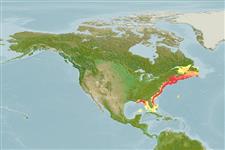
seewasser demersal; standorttreu; tiefenbereich 0 - 494 m (Ref. 57178), usually 110 - 185 m (Ref. 1371). Subtropical; 52°N - 23°N, 90°W - 53°W (Ref. 56857)
Northwest Atlantic: Canada to southern New England to the northeast coast of Florida; also found in the northeastern Gulf of Mexico.
Größe / Gewicht / Alter
Geschlechtsreife: Lm ? range ? - ? cm
Max length : 43.0 cm TL Männchen/unbestimmt; (Ref. 49746); common length : 17.0 cm TL Männchen/unbestimmt; (Ref. 1371)
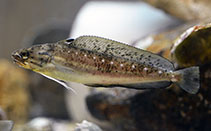
Rückenflossenstacheln (insgesamt) : 0; Afterflossenstacheln: 0. Upper limb of the first gill arch with 2 or 3 rakers. Head with a series of dark spots; opercle with a dusky blotch. First dorsal fin with a dark blotch and a distinct white margin.
Body shape (shape guide): fusiform / normal; Cross section: circular.
Found onshore, most common between 110 and 185 m. Feed on crustaceans, and possibly fish and squids. Juveniles spend part of their time in estuaries.
Lebenszyklus und Paarungsverhalten
Geschlechtsreife | Fortpflanzung | Ablaichen | Eier | Fruchtbarkeit | Larven
Cohen, D.M., T. Inada, T. Iwamoto and N. Scialabba, 1990. FAO species catalogue. Vol. 10. Gadiform fishes of the world (Order Gadiformes). An annotated and illustrated catalogue of cods, hakes, grenadiers and other gadiform fishes known to date. FAO Fish. Synop. 125(10). Rome: FAO. 442 p. (Ref. 1371)
IUCN Rote Liste Status (Ref. 130435: Version 2025-2 (Global))
Bedrohung für Menschen
Harmless
Nutzung durch Menschen
Fischereien: weniger kommerziell
Tools
Zusatzinformationen
Download XML
Internet Quellen
Schätzungen auf der Grundlage von Modellen
Bevorzugte Temperatur (Ref.
123201): 5.2 - 22.6, mean 7.6 °C (based on 46 cells).
Phylogenetischer Diversitätsindex (Ref.
82804): PD
50 = 0.5044 [Uniqueness, from 0.5 = low to 2.0 = high].
Bayesian length-weight: a=0.00490 (0.00406 - 0.00591), b=3.14 (3.09 - 3.19), in cm total length, based on LWR estimates for this species (Ref.
93245).
Trophische Ebene (Ref.
69278): 4.4 ±0.0 se; based on diet studies.
Widerstandsfähigkeit (Ref.
120179): mittel, Verdopplung der Population dauert 1,4 - 4,4 Jahre. (Preliminary K or Fecundity.).
Anfälligkeit der Fischerei (Ref.
59153): Low to moderate vulnerability (33 of 100).
🛈
Nährstoffe (Ref.
124155): Calcium = 69.2 [29.4, 153.8] mg/100g; Iron = 1.01 [0.55, 1.87] mg/100g; Protein = 18.6 [17.3, 20.0] %; Omega3 = 0.425 [0.220, 0.814] g/100g; Selenium = 34.2 [16.9, 71.4] μg/100g; VitaminA = 14.9 [4.4, 50.8] μg/100g; Zinc = 0.609 [0.413, 0.904] mg/100g (wet weight);