Classification / Noms
Noms communs | Synonymes | Catalog of Fishes(Genre, Espèce) | ITIS | CoL | WoRMS | Cloffa
>
Carangiformes (Jacks) >
Carangidae (Jacks and pompanos) > Caranginae
Etymology: Euprepocaranx: Name derived from Greek 'euprepes' meaning good-looking and Caranx, the type genus of Carangidae, referring to the beautiful body shape with long filamentous dorsal- and anal-fin
soft rays of the type species.
More on author: Gill.
Environnement : milieu / zone climatique / profondeur / gamme de distribution
Écologie
marin benthopélagique; océanodrome (Ref. 51243); profondeur 60 - 100 m (Ref. 37955). Tropical; 23°N - 1°S
Eastern Pacific: southern Baja California, Mexico to Ecuador and the Galapagos Islands.
Taille / Poids / Âge
Maturité: Lm ? range ? - ? cm
Max length : 60.0 cm TL mâle / non sexé; (Ref. 55763); common length : 30.0 cm TL mâle / non sexé; (Ref. 55763)
Description synthétique
Clés d'identification | Morphologie | Morphométrie
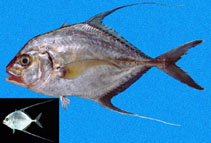
Body compressed and sub-oval in juveniles, oblong in adults; dorsal profile of snout slightly oblique, then abruptly vertical over anterior edge of premaxilla; lobes of second dorsal and anal fins very long; ventral part of chest scaleless up to origin of pectoral fins; body silvery blue with yellow golden highlights; dorsal side of operculum with a black spot; base of second dorsal fin membranes with small black spots (Ref. 55763).
Adults are found in oceanic waters (Ref. 9283). Marketed fresh and salted or dried (Ref. 9283).
Cycle de vie et comportement reproducteur
Maturité | Reproduction | Frai | Œufs | Fécondité | Larves
Kimura, S., S. Takeuchi and T. Yadome, 2022. Generic revision of the species formerly belonging to the genus Carangoides and its related genera (Carangiformes: Carangidae). Ichthyol. Res. 69(4):433-487. (Ref. 128022)
Statut dans la liste rouge de l'IUCN (Ref. 130435: Version 2025-2 (Global))
Menace pour l'homme
Harmless
Utilisations par l'homme
Pêcheries: commercial; pêche sportive: oui
Outils
Articles particuliers
Télécharger en XML
Sources Internet
Estimations basées sur des modèles
Température préférée (Réf.
123201): 15.5 - 24, mean 16.7 °C (based on 9 cells).
Indice de diversité phylogénétique (Réf.
82804): PD
50 = 1.0000 [Uniqueness, from 0.5 = low to 2.0 = high].
Bayesian length-weight: a=0.01445 (0.00849 - 0.02462), b=2.92 (2.78 - 3.06), in cm total length, based on LWR estimates for this species & (Sub)family-body (Ref.
93245).
Niveau trophique (Réf.
69278): 4.4 ±0.8 se; based on diet studies.
Résilience (Réf.
120179): Milieu, temps minimum de doublement de population : 1,4 à 4,4 années (Preliminary K or Fecundity.).
Vulnérabilité de la pêche (Ref.
59153): Moderate vulnerability (44 of 100).
🛈
Nutriments (Ref.
124155): Calcium = 59.2 [30.4, 166.2] mg/100g; Iron = 1.83 [0.80, 4.27] mg/100g; Protein = 18.8 [16.2, 21.0] %; Omega3 = 0.278 [0.132, 0.572] g/100g; Selenium = 17.6 [7.2, 45.7] μg/100g; VitaminA = 36.1 [5.4, 213.1] μg/100g; Zinc = 0.645 [0.314, 1.439] mg/100g (wet weight);