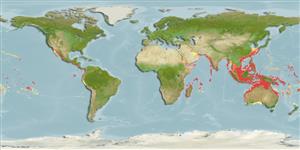
Environnement : milieu / zone climatique / profondeur / gamme de distribution
Écologie
marin; eau douce; saumâtre récifal; amphidrome; profondeur 0 - 146 m (Ref. 57178). Tropical; 26°C - 29°C; 32°N - 36°S, 25°E - 77°W
Indo-Pacific: Red Sea and East Africa to Hawaii, north to southern Japan and the Ogasawara Islands, south to Australia and New Caledonia. Eastern Pacific: southwestern coast of Baja California Sur, Mexico and the Gulf of California to Ecuador and the Galapagos Islands (Ref. 9283).
Longueur à la première maturité / Taille / Poids / Âge
Maturité: Lm 42.0 range ? - ? cm
Max length : 120 cm TL mâle / non sexé; (Ref. 9987); common length : 60.0 cm FL mâle / non sexé; (Ref. 3287); poids max. publié: 18.0 kg (Ref. 9987); âge max. reporté: 11 années (Ref. 82366)
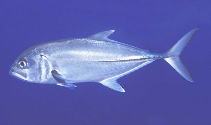
Épines dorsales (Total) : 9; Rayons mous dorsaux (Total) : 19 - 22; Épines anales: 3; Rayons mous anaux: 14 - 17; Vertèbres: 25. This species is distinguished by the following characters: dorsal profile moderately convex anteriorly; adipose eyelid well developed, moderate anteriorly, posterior eyelid extends onto eye to rear border of pupil; gill rakers (including rudiments) 6-8 + 15-19 = 21-25; straight part of lateral line with 0-3 anterior scales followed by 27-36 strong, dark scutes; breast completely scaly; vertebrae 10+15; upper jaw with outer row of strong canines widely spaced in adults, and an inner band of small villiform teeth, widest at symphysis; on lower limb of first gill arch jaw with a single row of strong conical teeth widely spaced in adults. Colour in life with adults' head and body silvery olive to iridescent blue-green above, silvery olive to whitish below; small blackish spot, much smaller than pupil diameter, at upper angle of opercle (this spot evident on specimens of about 14 cm fork length); second dorsal fin olive to blackish, the lobe with a white tip (white tip becomes more obvious with increasing size) (Ref. 9894).
Body shape (shape guide): fusiform / normal; Cross section: compressed.
Adults inhabit coastal and oceanic waters associated with reefs (Ref. 9283, 58302). Pelagic at 1-96 m (Ref. 58302). They are often seen in large daytime schools but solitary at night when feeding (Ref. 90102). During the day they are usually seen milling in stationary aggregations (Ref. 44894), forming slow-moving schools in the passes or outside the reef (Ref. 4795). Juveniles may be encountered in estuaries (Ref. 9283, 44894), occasionally entering rivers and penetrating well inland (Ref. 2847, 44894). Adults feed mainly on fishes, squids and crustaceans (Ref. 9283, Ref. 90102). They are caught mainly on hook-and-line; also with gill nets, purse seines, and other artisanal gear (Ref. 9894). Marketed fresh, dried or salted (Ref. 9283) and frozen (Ref. 9987). Consumed broiled and baked (Ref. 9987).
Cycle de vie et comportement reproducteur
Maturité | Reproduction | Frai | Œufs | Fécondité | Larves
Paxton, J.R., D.F. Hoese, G.R. Allen and J.E. Hanley, 1989. Pisces. Petromyzontidae to Carangidae. Zoological Catalogue of Australia, Vol. 7. Australian Government Publishing Service, Canberra, 665 p. (Ref. 7300)
Statut dans la liste rouge de l'IUCN (Ref. 130435: Version 2025-2 (Global))
Menace pour l'homme
Reports of ciguatera poisoning (Ref. 130160)
Utilisations par l'homme
Pêcheries: commercial; pêche sportive: oui
Outils
Articles particuliers
Télécharger en XML
Sources Internet
Estimations basées sur des modèles
Température préférée (Réf.
123201): 22.3 - 28.9, mean 27.3 °C (based on 2054 cells).
Indice de diversité phylogénétique (Réf.
82804): PD
50 = 0.5000 [Uniqueness, from 0.5 = low to 2.0 = high].
Bayesian length-weight: a=0.01738 (0.01431 - 0.02110), b=2.96 (2.93 - 2.99), in cm total length, based on LWR estimates for this species (Ref.
93245).
Niveau trophique (Réf.
69278): 4.5 ±0.6 se; based on diet studies.
Generation time: 4.6 ( na - na) years. Estimated as median ln(3)/K based on 1
growth studies.
Résilience (Réf.
120179): Milieu, temps minimum de doublement de population : 1,4 à 4,4 années (K=0.24; tmax=11;).
Prior r = 0.46, 95% CL = 0.30 - 0.68, Based on 1 data-limited stock assessment.
Vulnérabilité de la pêche (Ref.
59153): Moderate to high vulnerability (45 of 100).
🛈
Vulnérabilité climatique (Ref.
125649): High to very high vulnerability (72 of 100).
🛈
Nutriments (Ref.
124155): Calcium = 15.5 [7.0, 30.1] mg/100g; Iron = 0.33 [0.18, 0.64] mg/100g; Protein = 20.3 [18.1, 22.8] %; Omega3 = 0.14 [0.08, 0.23] g/100g; Selenium = 53.9 [26.8, 111.9] μg/100g; VitaminA = 57.2 [17.0, 188.6] μg/100g; Zinc = 0.439 [0.317, 0.628] mg/100g (wet weight);