>
Carangiformes (Jacks) >
Carangidae (Jacks and pompanos) > Caranginae
Etymology: Caranx: French, carangue, the name of a Caribbean fish; 1836 (Ref. 45335).
More on author: Bloch.
Milieu: milieu / Klimaatzone / Diepte / verspreidingsgebied
Ecologie
marien rifbewoner; oceanodroom (Ref. 51243); diepte 0 - 35 m (Ref. 40849), usually 0 - 22 m (Ref. 9710). Subtropical; 35°N - 33°N, 100°W - 33°W
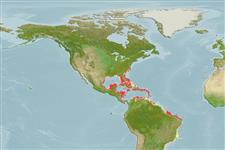
Western Atlantic: New Jersey (USA), Bermuda, and Gulf of Mexico to southern Brazil; throughout the Caribbean Sea (Ref. 9626). Most common in the West Indies (Ref. 26938).
Lengte bij maturiteit / Grootte / Gewicht / Leeftijd
Maturiteit: Lm 31.0, range 26 - ? cm
Max length : 73.0 cm FL mannelijk / geslacht onbekend; (Ref. 6937); common length : 50.0 cm TL mannelijk / geslacht onbekend; (Ref. 5217); max. gepubliceerd gewicht: 8.2 kg (Ref. 3277)
Korte beschrijving
Determinatiesleutels | Morfologie | Morfometrie
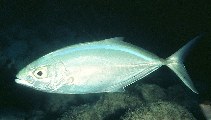
Dorsale stekels (totaal) : 8 - 9; Dorsale zachte stralen (totaal) : 26 - 30; Anale stekels: 2 - 3; Anale zachte stralen: 23 - 26.
Body shape (shape guide): fusiform / normal.
Common in clear insular areas or in coral reefs off mainland coasts (Ref. 5217). Juveniles frequent areas with algae (e.g. Sargassum) (Ref. 26235). Usually in schools which may be spawning groups; occasionally solitary. Feeds on fishes, shrimps and other invertebrates. Marketed fresh (Ref. 56217). Easily approached (Ref. 9710). Large individuals have caused ciguatera when eaten (Ref. 13442).
Berry, F.H. and W.F. Smith-Vaniz, 1978. Carangidae. In W. Fischer (ed.) FAO species identification sheets for fishery purposes. West Atlantic (Fishing Area 31). volume 1. FAO, Rome. [var. pag.]. (Ref. 3277)
Status op de Rode Lijst van het IUCN (Ref. 130435: Version 2025-2 (Global))
Gevaar voor de mens
Reports of ciguatera poisoning (Ref. 30302)
Gebruik door de mens
Visserij: commercieel; sportvis: ja
Tools
Speciale rapporten
Download XML
Internetbronnen
Schattingen op basis van modellen
Gewenste temperatuur (Ref.
123201): 23.2 - 28, mean 26.8 °C (based on 420 cells).
Fylogenetische diversiteitsindex (Ref.
82804): PD
50 = 0.5000 [Uniqueness, from 0.5 = low to 2.0 = high].
Bayesian length-weight: a=0.01514 (0.01238 - 0.01850), b=2.96 (2.93 - 2.99), in cm total length, based on LWR estimates for this species (Ref.
93245).
Trofisch niveau (Ref.
69278): 4.3 ±0.1 se; based on diet studies.
Generation time: 7.7 ( na - na) years. Estimated as median ln(3)/K based on 1
growth studies.
Weerstandsvermogen (Ref.
120179): Gemiddeld, minimale populatieverdubbelingstijd 1,4-4,4 jaar (K=0.14; tm=3).
Kwetsbaarheid van de visserij (Ref.
59153): High vulnerability (57 of 100).
🛈
Kwetsbaarheid voor het klimaat (Ref.
125649): Very high vulnerability (84 of 100).
🛈
Voedingsstoffen (Ref.
124155): Calcium = 13.4 [5.4, 24.9] mg/100g; Iron = 0.347 [0.166, 0.748] mg/100g; Protein = 20.6 [18.2, 23.0] %; Omega3 = 0.17 [0.09, 0.32] g/100g; Selenium = 16.9 [6.9, 41.2] μg/100g; VitaminA = 62.4 [20.7, 184.8] μg/100g; Zinc = 0.341 [0.224, 0.543] mg/100g (wet weight);