>
Carangiformes (Jacks) >
Carangidae (Jacks and pompanos) > Caranginae
Etymology: Decapterus: Greek, deka = ten + Greek, pteron = wing, fin (Ref. 45335).
More on author: Bleeker.
Entorno: milieu / zona climática / rango de profundidad / gama de distribución
Ecología
marino asociado a arrecife; rango de profundidad 20 - 214 m (Ref. 58302), usually 30 - 70 m (Ref. 37816). Tropical; 39°N - 34°S, 180°W - 180°E
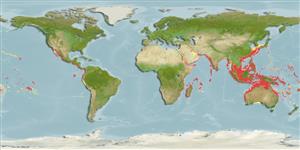
Southeast Atlantic: from Knysna to Natal, South Africa. Indian Ocean: along East Africa, Red Sea and Persian Gulf to Northwest Australia. Pacific: from South Korea, Australia and Central Pacific Islands, to Gulf of California to Peru, including Galapagos Islands (Ref. 9283). Recors in southwestern and South Australia are incorrect.
Longitud en la primera madurez / Tamaño / Peso / Edad
Madurez: Lm 16.8 range ? - ? cm
Max length : 35.0 cm TL macho / no sexado; (Ref. 3197); common length : 25.0 cm TL macho / no sexado; (Ref. 9137)
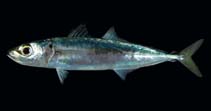
Espinas dorsales (total) : 9; Radios blandos dorsales (total) : 33 - 38; Espinas anales: 3; Radios blandos anales: 27 - 30. Body slender, elongate, and somewhat circular in cross section; posterior end of upper jaw concave dorsally and with a rounded protrusion ventrally; edge of shoulder girdle (cleithrum) with two small papillae, the lower one larger; dorsal and anal fin each followed by a separate finlet (Ref. 55763). Color metallic blue dorsally, silvery ventrally; fins hyaline; opercle with a small black spot (Ref. 2334). 24-40 scutes. Very slender compared to similar species (Ref. 48635).
Body shape (shape guide): fusiform / normal; Cross section: compressed.
A predominately pelagic schooling species (Ref. 9283, 48635, 58302). Occasionally seen in small groups along reef slopes adjacent to deep water in pursuit of zooplankton (Ref. 48635). Adults feed mainly on small invertebrates (Ref. 5213). Marketed fresh and salted or dried (Ref. 9283).
Paxton, J.R., D.F. Hoese, G.R. Allen and J.E. Hanley, 1989. Pisces. Petromyzontidae to Carangidae. Zoological Catalogue of Australia, Vol. 7. Australian Government Publishing Service, Canberra, 665 p. (Ref. 7300)
Situación en la Lista Roja de la UICN (Ref. 130435: Version 2025-2 (Global))
Amenaza para el ser humano
Harmless
Usos humanos
Pesquerías: comercial; carnada: usually
Herramientas
Informes especiales
Descargar XML
Fuentes de Internet
Estimaciones basadas en modelos
Temperatura preferida (Referencia
123201): 22.1 - 28.6, mean 27.3 °C (based on 829 cells).
Índice de diversidad filogenética (Referencia
82804): PD
50 = 0.5005 [Uniqueness, from 0.5 = low to 2.0 = high].
Bayesian length-weight: a=0.00977 (0.00833 - 0.01147), b=2.97 (2.94 - 3.00), in cm total length, based on LWR estimates for this species (Ref.
93245).
Nivel trófico (Referencia
69278): 3.4 ±0.45 se; based on food items.
Generation time: 1.2 (1.1 - 1.3) years. Estimated as median ln(3)/K based on 47
growth studies.
Resiliencia (Referencia
120179): Alto, población duplicada en un tiempo mínimo inferior a 15 meses (K=0.88; assumed tm=1-2; Fec>10,000).
Prior r = 1.11, 95% CL = 0.73 - 1.67, Based on 3 data-limited stock assessments.
Vulnerabilidad pesquera (Ref.
59153): Low vulnerability (16 of 100).
🛈
Nutrientes (Ref.
124155): Calcium = 252 [86, 571] mg/100g; Iron = 2.71 [1.03, 5.61] mg/100g; Protein = 20.4 [19.1, 21.6] %; Omega3 = 0.221 [0.118, 0.405] g/100g; Selenium = 73.4 [27.8, 171.8] μg/100g; VitaminA = 48.8 [16.3, 163.0] μg/100g; Zinc = 1.31 [0.80, 2.07] mg/100g (wet weight); based on
nutrient studies.