>
Carangiformes (Jacks) >
Carangidae (Jacks and pompanos) > Caranginae
Etymology: Hemicaranx: Greek, hemi = the half + French, carangue, the name of a Caribbean fish; 1836 (Ref. 45335).
More on author: Günther.
Lingkungan: lingkungan / zona iklim / kisaran kedalaman / jangkauan distribusi
Ekologi
laut; payau dasar (demersal). Tropical
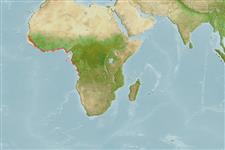
Eastern Atlantic: Along the west African coast from Sierra Leone to Angola (Ref. 57392). Reported from the Sine-Saloum Estuary in Senegal, the Gambia River in Gambia, the Fatala River in Guinea (Ref. 28587) and from Mauritania (Ref. 55783), but this is unconfirmed in Ref. 57392 and needs confirmation.
Ukuran / Berat / umur
Kematangan: Lm ? range ? - ? cm
Max length : 70.0 cm TL jantan/; (Ref. 57392); common length : 25.0 cm FL jantan/; (Ref. 3195)
deskripsi pendek
Kunci identifiaksi (pengenalan) | Morfologi | Morfometrik
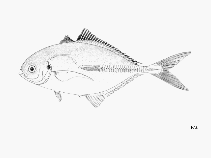
Duri punggung (Keseluruhan (total)) : 8; duri punggung lunak (Keseluruhan (total)) : 24 - 28; Duri dubur: 3; Sirip dubur lunak: 21 - 24. Diagnosis: body elongate (depth comprised 2.4-3.1 times in fork length) and strongly compressed; eyes small; snout short and rounded; mouth small; end of upper jaw extending to below anterior eye margin; teeth present in jaws, absent on vomer; 1st dorsal fin with 7 spines, 2nd dorsal with 1 spine and 24-28 soft rays; anal fin with 2 detached spines, followed by 1 spine and 21-24 soft rays; scales small and cycloid; breast completely scaleless; lateral line arched over anterior half of pectoral fins, its posterior (straight) part with 41-43 scutes; caudal peduncle very slender, without bilateral keels above and below last lateral line scutes (Ref. 57392).
Coloration: back bluish, sides silvery; black spot on upper margin of gill cover; dorsal- and upper caudal-fin lobes broadly black-edged, other fins light; juveniles with 4-5 dark crossbars on back and sides (Ref. 57392).
Body shape (shape guide): fusiform / normal.
Adults are found mainly in coastal areas, entering brackish water (Ref. 2683, 57392). Common mostly in midwater and near bottom (Ref. 7079). Young live in association with medusa (jellyfish) (Ref. 57392).
Smith-Vaniz, W.F., J.-C. Quéro and M. Desoutter, 1990. Carangidae. p. 729-755. In J.C. Quero, J.C. Hureau, C. Karrer, A. Post and L. Saldanha (eds.) Check-list of the fishes of the eastern tropical Atlantic (CLOFETA). JNICT, Lisbon; SEI, Paris; and UNESCO, Paris. Vol. 2. (Ref. 7097)
Status IUCN Red List (Ref. 130435: Version 2025-2 (Global))
ancaman kepada manusia
Harmless
penggunaan manusia
Perikanan: nilai komersial kecil
Alat, peralatan
laporan khas
muat turun XML
Sumber internet
Estimasi berdasarkan model
Suhu yang disukai (Acuan
123201): 24.4 - 27.9, mean 26.7 °C (based on 62 cells).
Indeks keanekaragaman filogenetik (Acuan
82804): PD
50 = 0.5625 [Uniqueness, from 0.5 = low to 2.0 = high].
Bayesian length-weight: a=0.01413 (0.00826 - 0.02417), b=2.92 (2.78 - 3.06), in cm total length, based on LWR estimates for this species & (Sub)family-body (Ref.
93245).
Tingkat Trofik (Acuan
69278): 3.9 ±0.6 se; based on size and trophs of closest relatives
Daya lenting (Acuan
120179): sedang, Waktu penggandaan populasi minimum 1.4 - 4.4 tahun (Preliminary K or Fecundity.).
Kerentanan Penangkapan Ikan (Ref.
59153): Moderate to high vulnerability (48 of 100).
🛈
Nutrisi (Ref.
124155): Calcium = 115 [78, 276] mg/100g; Iron = 1.24 [0.76, 2.35] mg/100g; Protein = 19.3 [18.3, 20.5] %; Omega3 = 0.248 [0.146, 0.435] g/100g; Selenium = 53.5 [29.9, 100.0] μg/100g; VitaminA = 13.3 [4.2, 32.3] μg/100g; Zinc = 1.06 [0.78, 1.46] mg/100g (wet weight);