>
Carangiformes (Jacks) >
Carangidae (Jacks and pompanos) > Scomberoidinae
Etymology: Oligoplites: Greek, oligos = small + Greek, hoplites = armed (Ref. 45335).
More on author: Günther.
Entorno: milieu / zona climática / rango de profundidad / gama de distribución
Ecología
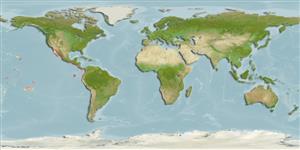
marino; salobre bentopelágico. Tropical; 32°N -
Eastern Pacific: Mexico to Peru.
Tamaño / Peso / Edad
Madurez: Lm ? range ? - ? cm
Max length : 56.0 cm FL macho / no sexado; (Ref. 40637); common length : 30.0 cm FL macho / no sexado; (Ref. 9283); peso máximo publicado: 1.6 kg (Ref. 40637)
Descripción breve
Claves de identificación | Morfología | Morfometría
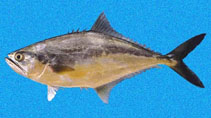
Body elongate, fairly deep, and compressed (depth from 2.5 to 3.4 times in standard length); posterior edge of upper jaw extending beyond posterior rim of eye; upper jaw teeth small and villiform; lower branch of first gill arch with 8 to 13 gill rakers; scales small but visible, needle-shaped, embedded in the skin; body gray or brown; flanks and belly silvery with yellow highlights (Ref. 55763).
Body shape (shape guide): fusiform / normal.
Adults inhabit coastal waters, entering estuaries (Ref. 9283). Dorsal and anal spines of this species are connected to venomous glands that may inflict painful wounds (Ref. 9283). Marketed fresh and salted or dried (Ref. 9283).
Ciclo vital y comportamiento de apareamiento
Madurez | Reproducción | Puesta | Huevos | Fecundidad | Larva
Smith-Vaniz, W.F., 1995. Carangidae. Jureles, pámpanos, cojinúas, zapateros, cocineros, casabes, macarelas, chicharros, jorobados, medregales, pez pilota. p. 940-986. In W. Fischer, F. Krupp, W. Schneider, C. Sommer, K.E. Carpenter and V. Niem (eds.) Guia FAO para Identification de Especies para lo Fines de la Pesca. Pacifico Centro-Oriental. 3 Vols. FAO, Rome. (Ref. 9283)
Situación en la Lista Roja de la UICN (Ref. 130435: Version 2025-2 (Global))
Amenaza para el ser humano
Usos humanos
Pesquerías: comercial
Herramientas
Informes especiales
Descargar XML
Fuentes de Internet
Estimaciones basadas en modelos
Temperatura preferida (Referencia
123201): 20 - 28.4, mean 24.9 °C (based on 70 cells).
Índice de diversidad filogenética (Referencia
82804): PD
50 = 0.5312 [Uniqueness, from 0.5 = low to 2.0 = high].
Bayesian length-weight: a=0.00955 (0.00612 - 0.01491), b=2.94 (2.81 - 3.07), in cm total length, based on LWR estimates for this species & Genus-body shape (Ref.
93245).
Nivel trófico (Referencia
69278): 4.1 ±0.0 se; based on diet studies.
Resiliencia (Referencia
120179): Medio, población duplicada en un tiempo mínimo de 1.4-4.4 años (Preliminary K or Fecundity.).
Vulnerabilidad pesquera (Ref.
59153): Moderate vulnerability (45 of 100).
🛈
Nutrientes (Ref.
124155): Calcium = 95.3 [58.5, 210.9] mg/100g; Iron = 1.01 [0.58, 2.01] mg/100g; Protein = 18.8 [17.6, 20.0] %; Omega3 = 0.253 [0.138, 0.478] g/100g; Selenium = 52 [27, 99] μg/100g; VitaminA = 23.8 [7.0, 65.1] μg/100g; Zinc = 1.17 [0.81, 1.68] mg/100g (wet weight);