>
Carangiformes (Jacks) >
Carangidae (Jacks and pompanos) > Caranginae
Etymology: Parastromateus: Greek, para in the side of + Greek, stromatos = a fish flattened body with a lot of colours (Stromateus sp.) (Ref. 45335).
More on author: Bloch.
Entorno: milieu / zona climática / rango de profundidad / gama de distribución
Ecología
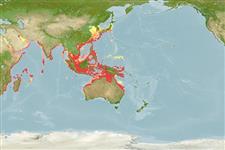
marino; salobre asociado a arrecife; anfidromo (Ref. 51243); rango de profundidad 15 - 105 m (Ref. 12260), usually 15 - 40 m (Ref. 54702). Tropical; 42°N - 30°S, 32°E - 154°E
Indo-West Pacific: East Africa to southern Japan and Australia.
Longitud en la primera madurez / Tamaño / Peso / Edad
Madurez: Lm 23.0, range 22 - 24 cm
Max length : 75.0 cm TL macho / no sexado; (Ref. 5284); common length : 30.0 cm TL macho / no sexado; (Ref. 3287)
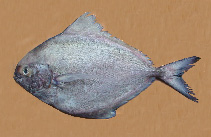
Espinas dorsales (total) : 2 - 6; Radios blandos dorsales (total) : 41 - 46; Espinas anales: 2; Radios blandos anales: 35 - 40; Vértebra: 24. Deep-bodied and strongly compressed fishes. Lateral line ends in weakly-developed scutes on the caudal peduncle. Pelvic fins lost in individuals over 9 cm. Color is brown above, silvery-white below. The anterior parts of the dorsal and anal fins bluish-gray. The other fins yellowish.
Body shape (shape guide): short and / or deep; Cross section: compressed.
Adults inhabit coastal areas with muddy substrate. Found near the bottom during daytime and near the surface at night. They also enter estuaries (Ref. 1479). Normally form large schools (Ref. 5213). Swim on its side near the surface (Ref. 3197). Feed on zooplankton (Ref. 30573). Excellent food fish (Ref. 3197); marketed fresh, may be dried or salted (Ref. 5284).
Paxton, J.R., D.F. Hoese, G.R. Allen and J.E. Hanley, 1989. Pisces. Petromyzontidae to Carangidae. Zoological Catalogue of Australia, Vol. 7. Australian Government Publishing Service, Canberra, 665 p. (Ref. 7300)
Situación en la Lista Roja de la UICN (Ref. 130435: Version 2025-2 (Global))
Amenaza para el ser humano
Harmless
Usos humanos
Pesquerías: muy comercial
Herramientas
Informes especiales
Descargar XML
Fuentes de Internet
Estimaciones basadas en modelos
Temperatura preferida (Referencia
123201): 24.3 - 29.1, mean 28.1 °C (based on 1436 cells).
Índice de diversidad filogenética (Referencia
82804): PD
50 = 1.0000 [Uniqueness, from 0.5 = low to 2.0 = high].
Bayesian length-weight: a=0.02512 (0.02090 - 0.03018), b=2.89 (2.84 - 2.94), in cm total length, based on LWR estimates for this species (Ref.
93245).
Nivel trófico (Referencia
69278): 2.9 ±0.35 se; based on food items.
Resiliencia (Referencia
120179): Medio, población duplicada en un tiempo mínimo de 1.4-4.4 años (K=0.3-1.03; Fec=1,692).
Prior r = 0.57, 95% CL = 0.37 - 0.85, Based on 15 data-limited stock assessments.
Vulnerabilidad pesquera (Ref.
59153): Moderate vulnerability (35 of 100).
🛈
Vulnerabilidad climática (Ref.
125649): Very high vulnerability (86 of 100).
🛈
Nutrientes (Ref.
124155): Calcium = 125 [23, 264] mg/100g; Iron = 0.892 [0.342, 2.262] mg/100g; Protein = 19.7 [18.3, 21.0] %; Omega3 = 0.112 [0.065, 0.213] g/100g; Selenium = 50.6 [24.2, 118.5] μg/100g; VitaminA = 27.8 [6.4, 116.0] μg/100g; Zinc = 0.594 [0.337, 1.944] mg/100g (wet weight); based on
nutrient studies.