>
Carangiformes (Jacks) >
Carangidae (Jacks and pompanos) > Caranginae
Etymology: Pseudocaranx: Greek, pseudes = false + French, carangue, the name of a Caribbean fish; 1836 (Ref. 45335).
Eponymy: J H Wright was said to have “presented many interesting specimens of Botany Bay fishes to the Australian Museum”. [...] (Ref. 128868), visit book page.
More on author: Whitley.
Ambiente: milieu / zona climática / intervalo de profundidade / gama de distribuição
Ecologia
marinhas; estuarina pelagic-neritic; intervalo de profundidade ? - 30 m (Ref. 33616). Temperate
Eastern Indian Ocean: southern Australia, from Western Australia to New South Wales.
Tamanho / Peso / Idade
Maturidade: Lm ? range ? - ? cm
Max length : 70.0 cm SL macho/indeterminado; (Ref. 9563)
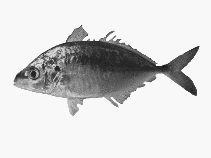
Espinhos dorsais (total) : 9; Raios dorsais moles (total) : 22 - 26; Espinhos anais: 3; Raios anais moles: 18 - 22; Vértebras: 24. This species is distinguished by the following characters: posterior margin of upper jaw canted posteroventrally; the lachrymal and expanded part of the maxilla densely covered with scales; a well-defined opercular spot, nearly solid black and approximately the diameter of the pupil; caudal vertebra 14; gill rakers, upper 10-15, lower 24-28, total 35-43; lateral line with 37-48 scales in the curved portion and 24-35 posterior scutes; never developing a yellow mid-lateral body stripe; second dorsal and anal fins transparent or dusky green, no yellow
pigmentation. (Ref. 76781).
Body shape (shape guide): fusiform / normal; Cross section: compressed.
Adults occur over sand and seagrass (Ref. 26068) in coastal waters including estuaries (Ref. 9563).
Ciclo de vida e comportamento de acasalamento
Maturidade | Reprodução | Desova | Ovos | Fecundidade | Larvas
Paxton, J.R., D.F. Hoese, G.R. Allen and J.E. Hanley, 1989. Pisces. Petromyzontidae to Carangidae. Zoological Catalogue of Australia, Vol. 7. Australian Government Publishing Service, Canberra, 665 p. (Ref. 7300)
Categoria na Lista Vermelha da IUCN (Ref. 130435: Version 2025-2 (Global))
Ameaça para o homem
Harmless
Utilização humana
Pescarias: pescarias de subsistência
Ferramentas
Relatórios especiais
Descarregue XML
Fontes da internet
Estimativas baseadas em modelos
Temperatura preferida (Ref.
123201): 16.1 - 22.8, mean 18 °C (based on 172 cells).
Índice de diversidade filogenética (Ref.
82804): PD
50 = 0.5625 [Uniqueness, from 0.5 = low to 2.0 = high].
Bayesian length-weight: a=0.01318 (0.00635 - 0.02739), b=2.96 (2.79 - 3.13), in cm total length, based on LWR estimates for this (Sub)family-body shape (Ref.
93245).
Nível Trófico (Ref.
69278): 3.4 ±0.3 se; based on diet studies.
Resiliência (Ref.
120179): Médio, tempo mínimo de duplicação da população 1,4 - 4,4 anos (Preliminary K or Fecundity.).
Vulnerabilidade da pesca (Ref.
59153): Moderate to high vulnerability (54 of 100).
🛈
Nutrientes (Ref.
124155): Calcium = 39 [19, 93] mg/100g; Iron = 0.518 [0.278, 1.036] mg/100g; Protein = 19.7 [18.5, 21.0] %; Omega3 = 0.612 [0.332, 1.186] g/100g; Selenium = 8.61 [3.98, 18.59] μg/100g; VitaminA = 9.84 [2.68, 35.36] μg/100g; Zinc = 0.663 [0.453, 0.947] mg/100g (wet weight);