>
Carangiformes (Jacks) >
Carangidae (Jacks and pompanos) > Trachinotinae
Etymology: Trachinotus: Greek, trachys, -eia, -ys = rough + Greek,noton = back (Ref. 45335).
Eponymy: C W Kennedy was Lieutenant Commander on the Hassler Expedition (1871–1872) from Boston to San Francisco via the Straits of Magellan. [...] (Ref. 128868), visit book page.
More on author: Steindachner.
Milieu: milieu / Klimaatzone / Diepte / verspreidingsgebied
Ecologie
marien; brak water demersaal. Tropical; 33°N - 20°S
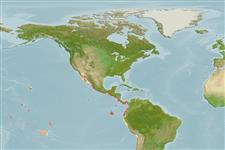
Eastern Pacific: Bahía Magdalena, Baja California Sur, Mexico and southern Gulf of California to Ecuador.
Grootte / Gewicht / Leeftijd
Maturiteit: Lm ? range ? - ? cm
Max length : 90.0 cm TL mannelijk / geslacht onbekend; (Ref. 55763); common length : 40.0 cm TL mannelijk / geslacht onbekend; (Ref. 55763)
Korte beschrijving
Determinatiesleutels | Morfologie | Morfometrie
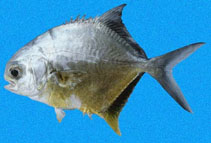
Body short, deep, and compressed; mouth small; teeth small, villiform, and only slightly hooked, didsappearing with age; lower branch of first gill arch with 9 to 12 gill rakers; dorsal fin with 6 spines followed by another spine and 17 to 19 soft rays (VII+I,17-19); nape prominent in adults; upper third of head and body dark; belly silvery; a dark axillary stain I covered by the pectoral fin (Ref. 55763).
Adults occur in coastal waters (Ref. 9283). They are common in shallow water and feed mainly on mollusks, but also take crustaceans and small fishes (Ref. 9283). Juveniles are frequently encountered in estuaries and feed on a variety of benthic invertebrates (Ref. 9283). Marketed fresh and salted or dried (Ref. 9283).
Levenscyclus en paargedrag
Maturiteit | Voortplanting | Paaien | Eieren | Fecunditeit | Larven
Smith-Vaniz, W.F., 1995. Carangidae. Jureles, pámpanos, cojinúas, zapateros, cocineros, casabes, macarelas, chicharros, jorobados, medregales, pez pilota. p. 940-986. In W. Fischer, F. Krupp, W. Schneider, C. Sommer, K.E. Carpenter and V. Niem (eds.) Guia FAO para Identification de Especies para lo Fines de la Pesca. Pacifico Centro-Oriental. 3 Vols. FAO, Rome. (Ref. 9283)
Status op de Rode Lijst van het IUCN (Ref. 130435: Version 2025-2 (Global))
Gevaar voor de mens
Harmless
Gebruik door de mens
Visserij: van minder commercieel belang; sportvis: ja
Tools
Speciale rapporten
Download XML
Internetbronnen
Schattingen op basis van modellen
Gewenste temperatuur (Ref.
123201): 20.8 - 28.5, mean 25.9 °C (based on 60 cells).
Fylogenetische diversiteitsindex (Ref.
82804): PD
50 = 0.5000 [Uniqueness, from 0.5 = low to 2.0 = high].
Bayesian length-weight: a=0.01479 (0.00793 - 0.02757), b=2.93 (2.76 - 3.10), in cm total length, based on LWR estimates for this species & (Sub)family-body (Ref.
93245).
Trofisch niveau (Ref.
69278): 3.8 ±0.55 se; based on food items.
Weerstandsvermogen (Ref.
120179): Gemiddeld, minimale populatieverdubbelingstijd 1,4-4,4 jaar (Preliminary K or Fecundity.).
Kwetsbaarheid van de visserij (Ref.
59153): High vulnerability (56 of 100).
🛈