>
Eupercaria/misc (Various families in series Eupercaria) >
Lutjanidae (Snappers) > Etelinae
Etymology: Pristipomoides: Greek, pristis = saw + Greek, poma, -atos = cover, operculum + Greek, oides = similar to (Ref. 45335).
More on authors: Goode & Bean.
Umwelt: Milieu / Klimazone / Tiefenbereich / Verbreitungsgebiet
Ökologie
seewasser demersal; tiefenbereich 24 - 370 m (Ref. 9626), usually 50 - 250 m (Ref. 9626). Subtropical; 41°N - 15°S, 99°W - 31°W (Ref. 55)
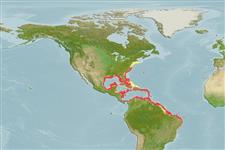
Western Atlantic: Canada (Ref. 5951) to North Carolina, USA and the Caribbean Sea to Santa Catarina, Brazil (Ref. 57756).
Größe / Gewicht / Alter
Geschlechtsreife: Lm ? range ? - ? cm
Max length : 56.0 cm TL Männchen/unbestimmt; (Ref. 40637); common length : 20.0 cm TL Männchen/unbestimmt; (Ref. 55); max. veröff. Gewicht: 2.0 kg (Ref. 40637)
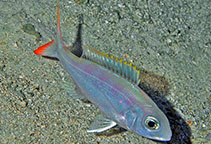
Rückenflossenstacheln (insgesamt) : 10; Rückenflossenweichstrahlen (insgesamt) : 10 - 11; Afterflossenstacheln: 3; Afterflossenweichstrahlen: 7 - 8. Interorbital space flat. The eyes large, its orbit almost touching head profile. Scale rows on back running parallel to the lateral line. Back and upper sides pink to reddish, becoming pink to silvery-white on belly; the fins are translucent to pinkish except for the outer part of the caudal and dorsal fins which are yellowish.
Body shape (shape guide): fusiform / normal; Cross section: oval.
A deep-water species. Feeds mainly on small fishes. A good food fish, it is marketed fresh, rarely frozen.
Lebenszyklus und Paarungsverhalten
Geschlechtsreife | Fortpflanzung | Ablaichen | Eier | Fruchtbarkeit | Larven
Allen, G.R., 1985. FAO Species Catalogue. Vol. 6. Snappers of the world. An annotated and illustrated catalogue of lutjanid species known to date. FAO Fish. Synop. 125(6):208 p. Rome: FAO. (Ref. 55)
IUCN Rote Liste Status (Ref. 130435: Version 2025-2 (Global))
Bedrohung für Menschen
Reports of ciguatera poisoning (Ref. 30303)
Nutzung durch Menschen
Fischereien: weniger kommerziell; Sportfisch: ja
Tools
Zusatzinformationen
Download XML
Internet Quellen
Schätzungen auf der Grundlage von Modellen
Bevorzugte Temperatur (Ref.
123201): 14.6 - 26.5, mean 22.1 °C (based on 219 cells).
Phylogenetischer Diversitätsindex (Ref.
82804): PD
50 = 0.5005 [Uniqueness, from 0.5 = low to 2.0 = high].
Bayesian length-weight: a=0.01479 (0.00853 - 0.02565), b=2.96 (2.82 - 3.10), in cm total length, based on LWR estimates for this species & Genus-body shape (Ref.
93245).
Trophische Ebene (Ref.
69278): 3.9 ±0.5 se; based on diet studies.
Widerstandsfähigkeit (Ref.
120179): mittel, Verdopplung der Population dauert 1,4 - 4,4 Jahre. (Preliminary K or Fecundity.).
Anfälligkeit der Fischerei (Ref.
59153): Moderate vulnerability (42 of 100).
🛈
Nährstoffe (Ref.
124155): Calcium = 63.8 [22.8, 133.1] mg/100g; Iron = 1.05 [0.56, 1.98] mg/100g; Protein = 18.7 [16.9, 20.4] %; Omega3 = 0.403 [0.252, 0.655] g/100g; Selenium = 35.6 [19.2, 70.1] μg/100g; VitaminA = 18.2 [5.9, 69.8] μg/100g; Zinc = 0.58 [0.39, 0.86] mg/100g (wet weight);