>
Eupercaria/misc (Various families in series Eupercaria) >
Lutjanidae (Snappers) > Etelinae
Etymology: Pristipomoides: Greek, pristis = saw + Greek, poma, -atos = cover, operculum + Greek, oides = similar to (Ref. 45335).
More on author: Valenciennes.
Meio ambiente: milieu / Zona climática / intervalo de profundidade / faixa de distribuição
Ecologia
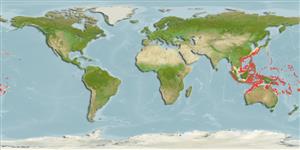
marinhas associadas(os) a recifes; intervalo de profundidade 70 - 350 m (Ref. 9821). Tropical; 35°N - 24°S, 98°E - 167°W (Ref. 55)
Indo-Pacific: East Africa to the Society Islands, north to southern Japan, south to New Caledonia.
Tamanho / Peso / Idade
Maturidade: Lm ? range ? - ? cm
Max length : 40.0 cm SL macho/indeterminado; (Ref. 9821); common length : 25.0 cm SL macho/indeterminado; (Ref. 9821); idade máx. registrada: 6 anos (Ref. 82366)
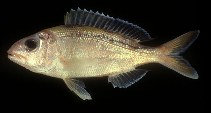
Espinhos dorsais (total) : 10; Raios dorsais (total) : 11; Espinhos anais: 3; Raios anais : 8. Interorbital space slightly convex. Preorbital depth 7.0 to 8.0 times in head length. Pectoral fins long, reaching level of anus. Scale rows on back parallel to lateral line. The upper part of the head reddish; the back mainly yellow; the sides and belly silvery, sometimes pinkish; body with very many bright blue spots and vermiculations. The dorsal and caudal fins yellowish.
Body shape (shape guide): fusiform / normal; Cross section: oval.
Adults are found over rocky bottoms. They feed on small fishes, crustaceans and squids.
Ciclo de vida ou comportamento de acasalamento
Maturidade | Reprodução | Desova | Ovos | Fecundidade | Larvas
Allen, G.R., 1985. FAO Species Catalogue. Vol. 6. Snappers of the world. An annotated and illustrated catalogue of lutjanid species known to date. FAO Fish. Synop. 125(6):208 p. Rome: FAO. (Ref. 55)
Status na Lista Vermelha da UICN (Ref. 130435: Version 2025-2 (Global))
Ameaça para os humanos
Harmless
Uso pelos humanos
Pescarias: pouco comercial
Ferramentas
Relatórios especiais
Baixar XML
Fontes da internet
Estimativas baseadas em modelos
Temperatura preferida (Ref.
123201): 15.2 - 26.2, mean 20.4 °C (based on 252 cells).
Índice de diversidade filogenética (Ref.
82804): PD
50 = 0.5005 [Uniqueness, from 0.5 = low to 2.0 = high].
Bayesian length-weight: a=0.01514 (0.00897 - 0.02555), b=3.00 (2.86 - 3.14), in cm total length, based on LWR estimates for this species & Genus-body shape (Ref.
93245).
Nível Trófico (Ref.
69278): 4.2 ±0.57 se; based on food items.
Resiliência (Ref.
120179): médio(a), tempo mínimo de duplicação da população 1,4 - 4,4 anos (K=0.5; tmax=6; .).
Vulnerabilidade da pesca (Ref.
59153): Moderate vulnerability (39 of 100).
🛈
Nutrientes (Ref.
124155): Calcium = 40.7 [22.0, 71.5] mg/100g; Iron = 0.638 [0.331, 1.057] mg/100g; Protein = 18.9 [17.0, 20.7] %; Omega3 = 0.184 [0.114, 0.294] g/100g; Selenium = 46.9 [27.3, 85.5] μg/100g; VitaminA = 116 [42, 380] μg/100g; Zinc = 0.863 [0.599, 1.221] mg/100g (wet weight);