>
Gadiformes (Cods) >
Moridae (Morid cods)
Etymology: microlepis: From the Greek 'micro' meaning small and 'lepis' meaning scale (Ref. 6885).
More on author: Bean.
Milieu: milieu / Klimaatzone / Diepte / verspreidingsgebied
Ecologie
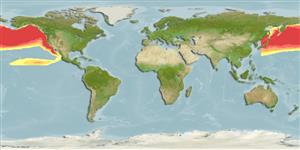
marien bathypelagisch; diepte 175 - 3048 m (Ref. 6793). Deep-water; 64°N - 12°N, 133°E - 106°W (Ref. 1371)
North Pacific: Shikoku Island, Japan to Navarin Canyon in the Bering Sea, the Gulf of California and Johnston Island.
Grootte / Gewicht / Leeftijd
Maturiteit: Lm ? range ? - ? cm
Max length : 75.0 cm TL mannelijk / geslacht onbekend; (Ref. 2850); max. gepubliceerd gewicht: 2.1 kg (Ref. 56581); max. gerapporteerde leeftijd: 20 Jaren (Ref. 56581)
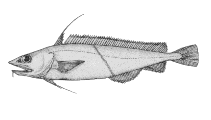
Dorsale stekels (totaal) : 0; Dorsale zachte stralen (totaal) : 54 - 60; Anale stekels: 0; Anale zachte stralen: 39 - 42. Head short; snout pointed; chin barbel short. Color variable from pale but definite blue gray or olive green throughout to deep violet or blue black; darker on outer edges of fins and very dark on edge of caudal and fins on ventral part of body; dark on lower part of gill cover and branchiostegals (Ref. 6885).
Body shape (shape guide): fusiform / normal; Cross section: oval.
Inhabits the lower regions of the continental slope between 800 m and 1, 800 m. It appears that sex segregation is also basic to this species, but whether or not the species migrates extensively or uses the North American west coast slopes only as feeding areas is not known (Ref. 1371). Benthopelagic (Ref. 58302). Feeds on benthic invertebrates (Ref. 9319). Taken frequently by deep slope water trawlers fishing for Microstomus pacificus and deepwater Sebastes species (Ref. 1371).
Levenscyclus en paargedrag
Maturiteit | Voortplanting | Paaien | Eieren | Fecunditeit | Larven
Cohen, D.M., T. Inada, T. Iwamoto and N. Scialabba, 1990. FAO species catalogue. Vol. 10. Gadiform fishes of the world (Order Gadiformes). An annotated and illustrated catalogue of cods, hakes, grenadiers and other gadiform fishes known to date. FAO Fish. Synop. 125(10). Rome: FAO. 442 p. (Ref. 1371)
Status op de Rode Lijst van het IUCN (Ref. 130435: Version 2025-2 (Global))
Gevaar voor de mens
Harmless
Gebruik door de mens
Visserij: visserij voor eigen gebruik
Tools
Speciale rapporten
Download XML
Internetbronnen
Schattingen op basis van modellen
Gewenste temperatuur (Ref.
123201): 0.2 - 3.9, mean 2.4 °C (based on 377 cells).
Fylogenetische diversiteitsindex (Ref.
82804): PD
50 = 0.7500 [Uniqueness, from 0.5 = low to 2.0 = high].
Bayesian length-weight: a=0.01259 (0.00663 - 0.02390), b=3.24 (3.07 - 3.41), in cm total length, based on LWR estimates for this species & (Sub)family-body (Ref.
93245).
Trofisch niveau (Ref.
69278): 3.5 ±0.37 se; based on food items.
Generation time: 12.2 ( na - na) years. Estimated as median ln(3)/K based on 1
growth studies.
Weerstandsvermogen (Ref.
120179): laag, minimale populatieverdubbelingstijd 4,5-14 jaar (Assuming tmax>10).
Kwetsbaarheid van de visserij (Ref.
59153): High to very high vulnerability (68 of 100).
🛈