>
Gadiformes (Cods) >
Moridae (Morid cods)
Etymology: Pseudophycis: Greek, pseudes = false + Greek, phykon = seaweed; because of the habit of living among them (Ref. 45335).
Eponymy: Bacchus was the Roman god of wine. Forster used a variant spelling of the name. (Ref. 128868), visit book page.
More on author: Forster.
Miljö: miljö / Klimatzon / djupintervall / distributionsområde
Ekologi
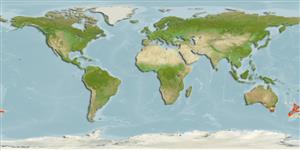
marina; brackvatten bottenlevande; djupintervall 26 - 700 m (Ref. 58489), usually 200 - 300 m (Ref. 54741). Subtropical; 33°S - 50°S, 137°E - 177°E (Ref. 54741)
Southwest Pacific: New Zealand and around Australia, at least from Sydney to Adelaide, and around Tasmania. Often confused with Pseudophycis barbata (Ref.9563).
Längd vid första mognad / Storlek / Vikt / Ålder
Könsmognad: Lm 52.0, range 45 - 55 cm
Max length : 90.0 cm TL hane/ej könsbestämd; (Ref. 1371); common length : 55.0 cm TL hane/ej könsbestämd; (Ref. 9258)
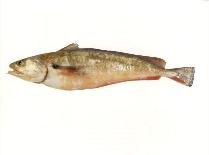
Taggstrålar i ryggfenan (totalt) : 0; Taggstrålar i analfenan: 0. Nostrils anterior to eye by about one-third of snout length. Pyloric caeca 6 to 8. Color reddish pink becoming paler ventrally, vertical fins with dark margins; a dark black blotch on the pectoral fin base.
Body shape (shape guide): fusiform / normal; Cross section: oval.
Found usually on soft muddy or sandy bottoms. Also on rocky bottoms, in estuaries, bays and continental shelf (Ref. 9563). In New Zealand, most abundant in 200 to 300 m along the edge of the continental shelf. May be found at depths exceeding 700 m (Ref. 9258). Feeds primarily on fishes, cephalopods, crabs and other crustaceans. Utilized as frozen fillets as well as fish blocks; eaten steamed, fried, microwaved and baked (Ref. 9988).
Livscykel och parningsbeteende
Könsmognad | Reproduktion | Lek | Ägg | Fekunditet | Larver
Cohen, D.M., T. Inada, T. Iwamoto and N. Scialabba, 1990. FAO species catalogue. Vol. 10. Gadiform fishes of the world (Order Gadiformes). An annotated and illustrated catalogue of cods, hakes, grenadiers and other gadiform fishes known to date. FAO Fish. Synop. 125(10). Rome: FAO. 442 p. (Ref. 1371)
Status på IUCN:s rödlista (Ref. 130435: Version 2025-2 (Global))
Hot mot människor
Harmless
Mänskliga användningsområden
Fiskeri: kommersiellt viktig; sportfisk: ja
Verktyg
Särskilda rapporter
Ladda ner XML
Internet-källor
Uppskattningar baserade på modeller
Önskad temperatur (Ref.
123201): 7.9 - 13.5, mean 11 °C (based on 43 cells).
Index för fylogenetisk mångfald (Ref.
82804): PD
50 = 0.6250 [Uniqueness, from 0.5 = low to 2.0 = high].
Bayesian length-weight: a=0.00589 (0.00299 - 0.01159), b=3.12 (2.94 - 3.30), in cm total length, based on LWR estimates for this species & (Sub)family-body (Ref.
93245).
Trofisk nivå (Ref.
69278): 3.9 ±0.6 se; based on diet studies.
Resiliens (Ref.
120179): Mellan, lägsta populationsfördubblingstid 1,4-4,4 år (K=0.4(?); tm=4; Fec~1million).
Prior r = 0.42, 95% CL = 0.27 - 0.62, Based on 5 data-limited stock assessments.
Sårbarhet i fisket (Ref.
59153): Low to moderate vulnerability (35 of 100).
🛈
Sårbarhet för klimatet (Ref.
125649): High to very high vulnerability (71 of 100).
🛈
Näringsämnen (Ref.
124155): Calcium = 56.8 [23.8, 116.8] mg/100g; Iron = 1.16 [0.65, 2.15] mg/100g; Protein = 19.6 [17.4, 21.5] %; Omega3 = 0.412 [0.214, 0.763] g/100g; Selenium = 47.5 [24.4, 100.0] μg/100g; VitaminA = 8.47 [2.69, 27.87] μg/100g; Zinc = 0.562 [0.389, 0.809] mg/100g (wet weight); based on
nutrient studies.