>
Cichliformes (Cichlids, convict blennies) >
Cichlidae (Cichlids) > Pseudocrenilabrinae
Etymology: Oreochromis: Latin, aurum = gold + Greek, chromis = a fish, perhaps a perch (Ref. 45335).
Eponymy: J W Graham (no other information available) collected the type in a hot soda lake in Kenya. (Ref. 128868), visit book page.
More on author: Boulenger.
Meio ambiente: milieu / Zona climática / intervalo de profundidade / faixa de distribuição
Ecologia
; Água doce bentopelágico; pH range: 7.5 - 8.5; dH range: 10 - 20. Tropical; 24°C - 32°C (Ref. 2060); 1°S - 2°S
Africa: Lake Magadi in Kenya (Ref. 52331). Introduced in Lake Nakuru and Lake Elmenteita, both in Kenya (Ref. 52331). Reported as introduced to Lake Natron in Tanzania (Ref. 13364), but there is currently no evidence that any introduction led to establishment of breeding populations (Ref. 118638).
Comprimento de primeira maturação / Tamanho / Peso / Idade
Maturidade: Lm ?, range 3 - ? cm
Max length : 20.0 cm SL macho/indeterminado; (Ref. 2)
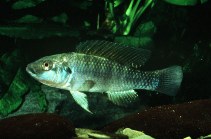
Espinhos dorsais (total) : 11 - 13; Raios dorsais (total) : 12 - 13; Espinhos anais: 3; Raios anais : 9 - 11; Vértebras: 28. Mature females with an overall golden hue; males with the flanks a pale blue. Swollen and brilliant white lateral parts of the lower lip of the mature male. Blue spots on scales becoming iridescent. Genital papilla conical, prominent and yellow in the mature male; swollen in the mature female. An oblique eye-bar intensely black in the breeding male, duller in the female.
Body shape (shape guide): short and / or deep; Cross section: compressed.
Facultative air-breathing (Ref. 126274); Occur at temperatures ranging from 16.0-40.0 °C (Ref. 2). Feed actively in the evening. Young O. alcalicus grahami eat eggs as they are shed by the female, and much of the time and energy of the territorial male is occupied in driving them off. Feed on invertebrates, at the surface (Ref. 2).
Ciclo de vida ou comportamento de acasalamento
Maturidade | Reprodução | Desova | Ovos | Fecundidade | Larvas
Male prepares a breeding pit, the structure of which may vary with the nature of the substratum. Breeding activities are more actively pursued by both sexes in the morning than in the afternoon. Female lays about 3-10 eggs at a time, picks them up instantly and the male swims with his genital papilla near the mouth, probably emitting sperm. Brooding period reportedly 12-16 days.
Seegers, L. and H. Tichy, 1999. The Oreochromis alcalicus flock (Teleostei: Cichlidae) from lakes Natron and Magadi, Tanzania and Kenya, with descriptions of two new species. Ichthyol. Explor. Freshwat. 10(2):97-146. (Ref. 32272)
Status na Lista Vermelha da UICN (Ref. 130435: Version 2025-2 (Global))
Ameaça para os humanos
Harmless
Uso pelos humanos
Aquário: Espécies comerciais
Ferramentas
Relatórios especiais
Baixar XML
Fontes da internet
Estimativas baseadas em modelos
Índice de diversidade filogenética (Ref.
82804): PD
50 = 0.5000 [Uniqueness, from 0.5 = low to 2.0 = high].
Bayesian length-weight: a=0.01905 (0.00846 - 0.04293), b=3.01 (2.82 - 3.20), in cm total length, based on LWR estimates for this (Sub)family-body shape (Ref.
93245).
Nível Trófico (Ref.
69278): 2.8 ±0.28 se; based on food items.
Resiliência (Ref.
120179): Elevada, tempo mínimo de duplicação da população menor que 15 meses (Preliminary K or Fecundity.).
Vulnerabilidade da pesca (Ref.
59153): Low vulnerability (14 of 100).
🛈