>
Cichliformes (Cichlids, convict blennies) >
Cichlidae (Cichlids) > Pseudocrenilabrinae
Etymology: Oreochromis: Latin, aurum = gold + Greek, chromis = a fish, perhaps a perch (Ref. 45335).
More on author: Hilgendorf.
Ambiente: milieu / zona climática / intervalo de profundidade / gama de distribuição
Ecologia
; Água doce bentopelágico. Tropical; 2°S - 3°S
Africa: known only from the catchment of Lake Natron, Tanzania and Kenya (Ref. 2, 5166, 118638).
Tamanho / Peso / Idade
Maturidade: Lm ? range ? - ? cm
Max length : 11.6 cm TL macho/indeterminado; (Ref. 32272)
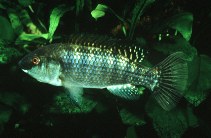
Espinhos dorsais (total) : 9 - 13; Raios dorsais moles (total) : 11 - 15; Espinhos anais: 3; Raios anais moles: 9 - 11; Vértebras: 27 - 30. Diagnosis: A small elongated species with a terminal mouth (Ref. 118638). Mature males have dark-edged dorsal and anal fins, iridescent blue-white spots on flanks, white lower lips, and a spotted caudal fin with a pink edge; they appear to be colour polymorphic, with some males having yellow bellies and throats, while others are blue white: both morphs can be found in the same location and the colours are stable in aquarium-held specimens, suggesting it is a true polymorphism and not related to reproductive state (Ref. 118638). Females and non-territorial males are sandy-coloured, pale ventrally, sometimes with faint vertical bars (Ref. 118638).
Body shape (shape guide): short and / or deep; Cross section: compressed.
Occurs at a temperature range of 30-32°C (Ref. 2). It feeds actively in the early morning; mainly on algae as well as copepods and dipterous larvae (Ref. 2). A maternal mouthbrooder: males excavate pits in the substrate in shallow water (Ref. 2, 118638). The species is occasionally caught as a food fish in its natural range; although it attains a small size, its tolerance of hostile environments may make it suitable for culture in high salinity environments; potential as an aquarium fish (Ref. 118638). Classed as endangered, due to its restricted distribution (Ref. 118638).
Ciclo de vida e comportamento de acasalamento
Maturidade | Reprodução | Desova | Ovos | Fecundidade | Larvas
Early in the morning before taking possession of their pits, the males feed on slimy algal growths-noisily; sexual activity is greater after noon than before; young male may build a small pit around that of a larger male and mate there with a small female (Ref. 2). Males prepare and guard nests, while females migrate from one nest to another; males guard the nest against juveniles of their own species and other species which feed on the fertilized eggs which fall from the mouth of the female mouth brooder (Ref. 11288). Also Ref. 118638.
Seegers, L. and H. Tichy, 1999. The Oreochromis alcalicus flock (Teleostei: Cichlidae) from lakes Natron and Magadi, Tanzania and Kenya, with descriptions of two new species. Ichthyol. Explor. Freshwat. 10(2):97-146. (Ref. 32272)
Categoria na Lista Vermelha da IUCN (Ref. 130435: Version 2025-2 (Global))
Ameaçada (EN) (B1ab(i,ii,iii)+2ab(i,ii,iii)); Date assessed: 31 January 2006
Ameaça para o homem
Harmless
Utilização humana
Ferramentas
Relatórios especiais
Descarregue XML
Fontes da internet
Estimativas baseadas em modelos
Índice de diversidade filogenética (Ref.
82804): PD
50 = 0.5000 [Uniqueness, from 0.5 = low to 2.0 = high].
Bayesian length-weight: a=0.01905 (0.00846 - 0.04293), b=3.01 (2.82 - 3.20), in cm total length, based on LWR estimates for this (Sub)family-body shape (Ref.
93245).
Nível Trófico (Ref.
69278): 2.7 ±0.21 se; based on food items.
Resiliência (Ref.
120179): Elevada, tempo mínimo de duplicação da população menor que 15 meses (Preliminary K or Fecundity.).
Vulnerabilidade da pesca (Ref.
59153): Low vulnerability (10 of 100).
🛈