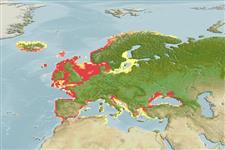
Entorno: milieu / zona climática / rango de profundidad / gama de distribución
Ecología
marino; agua dulce; salobre demersal; pH range: 7.5 - ? ; dH range: 10 - 20; anadromo (Ref. 138126); rango de profundidad 4 - 93 m (Ref. 51346), usually 5 - 60 m (Ref. 26160). Temperate; 10°C - 18°C (Ref. 2059); 71°N - 34°N, 25°W - 42°E (Ref. 59043)
Currently restricted only to the Garonne River in France (Ref. 137675).
Used to range from Norway to the Bay of Biscay, including the North Sea, European coasts of Atlantic, northern Mediterranean eastward to Rhodos, western and southern Black Sea; occasionally recorded from the White Sea, Iceland, Morocco and Algeria. Anadromous, in most large rivers, but not recorded from Danube upriver of delta.
Recent DNA studies using museum specimens revealed that this species co-exists with A. naccarii from the Adriatic Sea to the Iberian Peninsula (Ref. 52173). Several DNA sequence differences were found between individuals of the species from the Gironde River population and from the North and Baltic Seas showing that different populations of A. sturio are genetically divergent (Ref. 82476).
Longitud en la primera madurez / Tamaño / Peso / Edad
Madurez: Lm ?, range 165 - ? cm
Max length : 600 cm TL macho / no sexado; (Ref. 59043); common length : 125 cm TL macho / no sexado; (Ref. 3397); peso máximo publicado: 400.0 kg (Ref. 556); peso máximo publicado: 400.0 kg; edad máxima reportada: 100 años (Ref. 556)
Descripción breve
Claves de identificación | Morfología | Morfometría
Espinas dorsales (total) : 0; Radios blandos dorsales (total) : 30 - 44; Espinas anales: 0; Radios blandos anales: 23 - 30. Body elongated, pentagonal section (Ref. 51442). Snout moderate with tip narrow and pointed (Ref. 3397), mouth inferior (Ref. 59043). Lower lip not continuous, interrupted at center (Ref. 3397). Four barbels halfway between snout tip and mouth but not reaching the latter (Ref. 3397, Ref. 51442). No scales, but 5 rows of scutes on the body: dorsal 9-16, lateral 24-39 on each side, ventral 9-14 on each side, with dense cross-lines of smaller rhombic plates between the dorsal and lateral rows (Ref. 2196, Ref. 3397, Ref. 40476, Ref. 51442). Dorsal side greenish-brown to blackish with golden tints, flanks light with silvery tints, belly white (Ref. 3397).
Body shape (shape guide): elongated.
Amphihaline and anadromous fish (Ref. 51346, 51439), frequenting littoral zones (Ref. 2163, 51439, 51442). A long-lived and slow-growing species (Ref. 9988). It lives the major part of his life in sea but enters rivers for reproduction (Ref. 30578, 51442). Found on various substrates, from sand to rocks (Ref. 51346). At the sea, it occurs in coastal and estuarine zones. In freshwaters, it inhabits estuaries and large rivers (Ref. 59043). Juveniles found both in estuaries and in the sea (Ref. 2163), they slowly adapt to saltwater (Ref. 89103) and usually spend around 2-3 years in river estuaries before moving to the sea (Ref. 40152), some may migrate to the sea during their first summer (Ref. 59043). Usually solitary. Feeds on crustaceans, mollusks, polychaete worms and small fish. Today most males only reach 100-150 cm length, females 130-215 cm (Ref. 59043, 89104). Utilized fresh and frozen, and also for caviar; eaten steamed, pan-fried, broiled, boiled, microwaved and baked (Ref. 9988). A threatened species, mainly due to bycatch, poaching, habitat degradation (spawning grounds, nursery areas) and physical obstacles to migration (Ref. 26160).
Anadromous species, with adults migrating to the middle reaches of large rivers mainly in spring and early summer. Spawning occurs between March and August, when water temperature rises above 20 °C at depths of 2-10 m over stony bottoms in areas with strong current (1.5-2.0 m/s) (Ref. 51442, 59043, 89103).
Mature individuals do not feed during spawning migration (Ref. 3193). Number of spawned eggs increases with age. After spawning adults return to the sea (Ref. 51442). The development of the sticky dark grey eggs (2.6-3.0 mm diameter) takes about one week at 17°C (Ref. 26160, 35388).
It is suggested that males spawn every 2 years, females every 3-4 years (Ref. 89072). Upstream spawning migrations appear to be positively correlated with water levels in rivers and distances of 1,000 kilometres or more may be covered when water levels are high (Ref. 89104).
Sturgeons in general have a high capacity for hybridization and most species are able to cross-breed (Ref. 89103, 89117). This species has been reported to cross-breed (albeit rarely) with the Danube sturgeon (Acipenser gueldenstaedti) (Ref. 89105).
Bauchot, M.-L., 1987. Poissons osseux. p. 891-1421. In W. Fischer, M.L. Bauchot and M. Schneider (eds.) Fiches FAO d'identification pour les besoins de la pêche. (rev. 1). Méditerranée et mer Noire. Zone de pêche 37. Vol. II. Commission des Communautés Européennes and FAO, Rome. (Ref. 3397)
Situación en la Lista Roja de la UICN (Ref. 130435: Version 2025-2 (Global))
Amenaza para el ser humano
Harmless
Usos humanos
Pesquerías: comercial; Acuicultura: comercial
Herramientas
Informes especiales
Descargar XML
Fuentes de Internet
Estimaciones basadas en modelos
Temperatura preferida (Referencia
123201): 7.3 - 18.8, mean 11 °C (based on 738 cells).
Índice de diversidad filogenética (Referencia
82804): PD
50 = 0.5000 [Uniqueness, from 0.5 = low to 2.0 = high].
Bayesian length-weight: a=0.00263 (0.00153 - 0.00452), b=3.14 (3.00 - 3.28), in cm total length, based on LWR estimates for this species & Genus-body shape (Ref.
93245).
Nivel trófico (Referencia
69278): 3.5 ±0.51 se; based on food items.
Generation time: 36.6 ( na - na) years. Estimated as median ln(3)/K based on 1
growth studies.
Resiliencia (Referencia
120179): Muy bajo, población duplicada en un tiempo mínimo superior a 14 años (tm=7-20; tmax=100).
Vulnerabilidad pesquera (Ref.
59153): Very high vulnerability (88 of 100).
🛈
Vulnerabilidad climática (Ref.
125649): Moderate to high vulnerability (47 of 100).
🛈
Nutrientes (Ref.
124155): Calcium = 8.49 [4.38, 16.01] mg/100g; Iron = 0.212 [0.119, 0.345] mg/100g; Protein = 17.7 [15.1, 20.3] %; Omega3 = 0.293 [0.144, 0.603] g/100g; Selenium = 30.4 [14.0, 64.8] μg/100g; VitaminA = 3.3 [1.0, 11.0] μg/100g; Zinc = 0.403 [0.274, 0.606] mg/100g (wet weight);