Umwelt: Milieu / Klimazone / Tiefenbereich / Verbreitungsgebiet
Ökologie
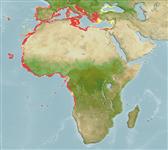
seewasser demersal; tiefenbereich 15 - 400 m (Ref. 26999). Subtropical; 45°N - 15°S, 26°W - 36°E
Eastern Atlantic: Mediterranean and the Adriatic Sea (Ref. 12382); Mauritania to Angola, including Madeira, Cape Verde and the Canary Islands (Ref. 5979).
Länge bei der ersten Reifung / Größe / Gewicht / Alter
Geschlechtsreife: Lm 20.4 range ? - ? cm
Max length : 45.0 cm TL Männchen/unbestimmt; (Ref. 27584); common length : 13.0 cm TL Männchen/unbestimmt; (Ref. 3397); max. veröff. Gewicht: 700.00 g (Ref. 27584); max. veröff. Alter: 6 Jahre (Ref. 127561)
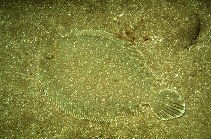
Rückenflossenweichstrahlen (insgesamt) : 85 - 95; Afterflossenweichstrahlen: 63 - 73. The scales on the eyed side are ctenoid and cycloid on the blind side. The inter-orbital width is much wider in males. The upper pectoral fin rays are not prolonged. The subspecies in the Mediterranean and African coast, P. podas has 75-86 lateral line scales, with 13-20 scales making up the curved portion. Its eyed side has alight brown color, bearing darker spots. The subspecies in Madeira and the Canaries, B. p. maderensis, has 88-91 lateral line scales, with 20-21 on the lateral line curve. Its eyed side appears dark brown to dark violet and seldom spotted.
Body shape (shape guide): short and / or deep; Cross section: flattened.
Found in shallow waters, over sandy and muddy bottoms of the continental plateau (Ref. 5377, 12382). Feeds on benthic small fishes and invertebrates. Reproduction occurs between May and August. Small individuals adapt well in aquariums but require sufficient bottom areas (Ref. 12382).
Aldebert, Y., M. Desoutter and J.-C. Quéro, 1990. Bothidae. p. 1027-1036. In J.C. Quero, J.C. Hureau, C. Karrer, A. Post and L. Saldanha (eds.) Check-list of the fishes of the eastern tropical Atlantic (CLOFETA). JNICT, Lisbon; SEI, Paris; and UNESCO, Paris. Vol. 2. (Ref. 5979)
IUCN Rote Liste Status (Ref. 130435: Version 2025-2 (Global))
Bedrohung für Menschen
Harmless
Nutzung durch Menschen
Fischereien: kommerziell; Aquarium: Kommerziell
Tools
Zusatzinformationen
Download XML
Internet Quellen
Schätzungen auf der Grundlage von Modellen
Bevorzugte Temperatur (Ref.
123201): 13 - 17.6, mean 15.1 °C (based on 199 cells).
Phylogenetischer Diversitätsindex (Ref.
82804): PD
50 = 0.5000 [Uniqueness, from 0.5 = low to 2.0 = high].
Bayesian length-weight: a=0.00891 (0.00708 - 0.01122), b=3.05 (3.00 - 3.10), in cm total length, based on LWR estimates for this species (Ref.
93245).
Trophische Ebene (Ref.
69278): 3.4 ±0.4 se; based on diet studies.
Widerstandsfähigkeit (Ref.
120179): mittel, Verdopplung der Population dauert 1,4 - 4,4 Jahre. (K=0.43; tmax=6; tm=1.67;).
Anfälligkeit der Fischerei (Ref.
59153): Low to moderate vulnerability (35 of 100).
🛈
Nährstoffe (Ref.
124155): Calcium = 68.8 [28.8, 130.4] mg/100g; Iron = 0.851 [0.417, 1.517] mg/100g; Protein = 17.9 [16.6, 19.3] %; Omega3 = 0.212 [0.112, 0.389] g/100g; Selenium = 37.7 [18.6, 80.9] μg/100g; VitaminA = 9.51 [2.40, 36.37] μg/100g; Zinc = 0.65 [0.44, 0.94] mg/100g (wet weight);