>
Siluriformes (Catfishes) >
Clariidae (Airbreathing catfishes)
Etymology: Clarias: Greek, chlaros = lively, in reference to the ability of the fish to live for a long time out of water.
More on author: Günther.
Ambiente: milieu / zona climatica / distribuzione batimetrica / gamma di distribuzione
Ecologia
; acqua dolce demersale; pH range: 6.0 - 7.5; dH range: ? - 25. Tropical; 22°C - 28°C (Ref. 12468); 5°N - 8°S
Africa: basins of the Ogooué, Noya (Muni River tributary), Kouilou and Chiloango (Ref. 81644), as well as in the lower and middle Congo River basin including Lake Tumba and Pool Malebo (Ref. 248). Also reported from the upper Congo (Ref. 106245).
Dimensione / Peso / Età
Maturità: Lm ? range ? - ? cm
Max length : 36.0 cm TL maschio/sesso non determinato; (Ref. 3820)
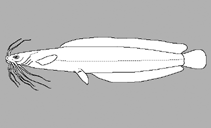
Spine dorsali (totale) : 0; Raggi dorsali molli (totale) : 72 - 88; Raggi anali molli: 56 - 71; Vertebre: 55 - 71. Diagnosis: head length 24.4-27.7% SL (Ref. 81644, 101841). Head rather pointed in dorsal outline; snout slightly rounded; eyes located more dorsally (Ref. 248). Interorbital distance 41.1-45.4% HL (Ref. 101841). Tooth plates relatively small (Ref 248), width of premaxillary tooth plate 21.3-28.2% HL, and of vomerine tooth plate 18.6-25.9% HL (Ref. 101841). Nasal barbel 78.3-110% HL; outer mandibular barbel 58.0-142% HL (Ref. 101841). Frontal fontanelle short and squat (`sole-shaped'); occipital fontanelle small and oval-shaped; `dermosphenotic' and supraorbital bones become sutured in larger specimens (above 65 mm SL) (Ref. 248). Pectoral spine robust, slightly curved (Ref. 248) and strongly serrated on outside and inside (Ref. 81644, 101841). Number of gill rakers varies with standard length (Ref. 248), 16-28 on first gill arch (Ref. 81644). Suprabranchial organ well developed, nearly filling the cavity (Ref. 248). Openings of the lateral branches of the lateral line irregularly placed (Ref. 248, 81644). 56-71 anal fin rays (Ref. 81644). Large part of bony surface of cleithrum exposed through the skin; posterior border of visible part sometimes forms almost straight line; cleithrum length 21.5-26.0% HL; dorsal fin length 65.7-75.0% SL; distance from dorsal to caudal fin 0.0-2.5% SL (Ref. 101841).
Colouration: brownish yellow in life; pigmentation may be uniform but is more often marbled, with many, small yellowish spots (Ref. 81644, 101841). Distal quarter of caudal fin is clearer than anterior portion (Ref. 248, 81644, 101841). Some specimens may show irregular pattern of small white spots on body (Ref. 101841).
Body shape (shape guide): elongated; Cross section: oval.
Facultative air-breathing (Ref. 126274); Found in lakes, rivers and floodplains (during breeding season); stomach contents consisted of sand, plants, larvae of Ephemeroptera, Trichoptera and Chironomidae, remains of insects and fish scales (Ref. 248, 78218).
Ciclo vitale e comportamento di accoppiamento
Maturità | Riproduzione | Deposizione | Uova | Fecondità | Larve
Juvenile specimens were found in isolated pools in the forest which might indicate that reproduction takes place during the rainy season.
Teugels, G.G., 1986. A systematic revision of the African species of the genus Clarias (Pisces; Clariidae). Ann. Mus. R. Afr. Centr., Sci. Zool., 247:199 p. (Ref. 248)
Stato della Lista Rossa IUCN (Ref. 130435: Version 2025-2 (Global))
Minaccia per l'uomo
Harmless
Usi umani
Strumenti
Rapporti speciali
Scarica XML
Fonti Internet
Stime basate su modelli
Indice di diversità filogenetica (Fonte Biblio.
82804): PD
50 = 0.5000 [Uniqueness, from 0.5 = low to 2.0 = high].
Bayesian length-weight: a=0.00776 (0.00372 - 0.01620), b=2.96 (2.79 - 3.13), in cm total length, based on LWR estimates for this Genus-body shape (Ref.
93245).
Livello trofico (Fonte Biblio.
69278): 3.3 ±0.47 se; based on food items.
Resilienza (Fonte Biblio.
120179): Alto, tempo minimo di raddoppiamento della popolazione meno di 15 mesi (Preliminary K or Fecundity.).
Vulnerabilità della pesca (Ref.
59153): Low to moderate vulnerability (26 of 100).
🛈
Nutrienti (Ref.
124155): Calcium = 37.7 [18.4, 185.5] mg/100g; Iron = 1.57 [0.90, 2.69] mg/100g; Protein = 16.7 [15.7, 17.8] %; Omega3 = 0.249 [0.084, 0.695] g/100g; Selenium = 122 [42, 312] μg/100g; VitaminA = 35.6 [12.8, 99.7] μg/100g; Zinc = 0.936 [0.651, 1.321] mg/100g (wet weight);