>
Eupercaria/misc (Various families in series Eupercaria) >
Lutjanidae (Snappers) > Etelinae
Etymology: Pristipomoides: Greek, pristis = saw + Greek, poma, -atos = cover, operculum + Greek, oides = similar to (Ref. 45335).
More on author: Valenciennes.
Entorno: milieu / zona climática / rango de profundidad / gama de distribución
Ecología
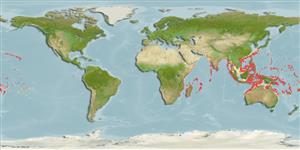
marino bentopelágico; rango de profundidad 70 - 300 m (Ref. 9821), usually 125 - 275 m (Ref. 82366). Deep-water; 35°N - 29°S, 34°E - 146°W (Ref. 55)
Indo-Pacific: East Africa to Hawaii and Tahiti, north to southern Japan, south to Australia and Lord Howe Island.
Tamaño / Peso / Edad
Madurez: Lm ? range ? - ? cm
Max length : 57.5 cm FL macho / no sexado; (Ref. 107958); common length : 35.0 cm TL macho / no sexado; (Ref. 30573); peso máximo publicado: 1.8 kg (Ref. 4887)
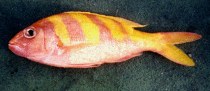
Espinas dorsales (total) : 10; Radios blandos dorsales (total) : 10 - 11; Espinas anales: 3; Radios blandos anales: 8. Interorbital space convex. Jaws about equal, or lower jaw slightly protruding. Bases of dorsal and anal fins without scales, their last soft rays extended into short filaments. Pectoral fins long, reaching level of anus. Scale rows on back parallel to lateral line. Overall color pink or reddish with four oblique orange or yellow bars on the sides; the dorsal and caudal fins yellow.
Body shape (shape guide): fusiform / normal; Cross section: oval.
Adults occur over rocky bottoms (Ref. 30573) of the continental shelf and slope (Ref. 75154). They feed on fishes, shrimps, crabs, cephalopods, miscellaneous benthic invertebrates and pelagic organisms, including urochordates.
Ciclo vital y comportamiento de apareamiento
Madurez | Reproducción | Puesta | Huevos | Fecundidad | Larva
Allen, G.R., 1985. FAO Species Catalogue. Vol. 6. Snappers of the world. An annotated and illustrated catalogue of lutjanid species known to date. FAO Fish. Synop. 125(6):208 p. Rome: FAO. (Ref. 55)
Situación en la Lista Roja de la UICN (Ref. 130435: Version 2025-2 (Global))
Amenaza para el ser humano
Harmless
Usos humanos
Pesquerías: comercial; pesca deportiva: si
Herramientas
Informes especiales
Descargar XML
Fuentes de Internet
Estimaciones basadas en modelos
Temperatura preferida (Referencia
123201): 12.3 - 23, mean 16.9 °C (based on 356 cells).
Índice de diversidad filogenética (Referencia
82804): PD
50 = 0.5005 [Uniqueness, from 0.5 = low to 2.0 = high].
Bayesian length-weight: a=0.01349 (0.00781 - 0.02329), b=2.94 (2.80 - 3.08), in cm total length, based on LWR estimates for this species & Genus-body shape (Ref.
93245).
Nivel trófico (Referencia
69278): 4.0 ±0.0 se; based on diet studies.
Generation time: 4.7 ( na - na) years. Estimated as median ln(3)/K based on 2
growth studies.
Resiliencia (Referencia
120179): Bajo, población duplicada en un tiempo mínimo de 4.5-14 años (K=0.23-1.09; tmax=13;).
Vulnerabilidad pesquera (Ref.
59153): Moderate vulnerability (42 of 100).
🛈
Nutrientes (Ref.
124155): Calcium = 15.9 [6.9, 40.2] mg/100g; Iron = 0.353 [0.155, 0.749] mg/100g; Protein = 17.1 [15.3, 18.9] %; Omega3 = 0.356 [0.155, 0.696] g/100g; Selenium = 16.6 [7.2, 36.3] μg/100g; VitaminA = 24.9 [5.4, 125.5] μg/100g; Zinc = 0.365 [0.238, 0.567] mg/100g (wet weight);