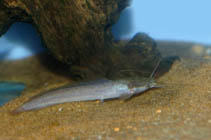
>
Siluriformes (Catfishes) >
Clariidae (Airbreathing catfishes)
Etymology: Clarias: Greek, chlaros = lively, in reference to the ability of the fish to live for a long time out of water.
More on author: Lönnberg.
Umwelt: Milieu / Klimazone / Tiefenbereich / Verbreitungsgebiet
Ökologie
; süßwasser demersal. Tropical; 23°C - 28°C (Ref. 12468); 9°N - 11°S
Africa: from Volta basin in Ghana (Ref. 57129) and coastal rivers in Togo to the lower and middle Congo River basin (Ref. 248); also reported from the upper Congo (Ref. 106245). Widespread in Lower Guinea, from the Cross in Nigeria and Cameroon to the Loémé in Republic of Congo (Ref. 81644).
Größe / Gewicht / Alter
Geschlechtsreife: Lm ? range ? - ? cm
Max length : 46.6 cm TL Männchen/unbestimmt; (Ref. 57129)
Rückenflossenstacheln (insgesamt) : 0; Rückenflossenweichstrahlen (insgesamt) : 69 - 94; Afterflossenweichstrahlen: 52 - 70; Wirbelzahl: 56 - 61. Diagnosis: body less elongate, its maximum depth 11.9-16.4% SL (m=14.1); head length 21.0-26.0% SL (m=24.1) (Ref. 57129, 81644). Head rectangular dorsally; snout extremely broadly rounded; eyes more laterally placed (Ref. 248). Interorbital distance 45.4-54.3% HL (m=48.8) (Ref. 57129, 81644). Tooth plates extremely broad (Ref. 248), width of premaxillary tooth plate 30.4-38.9% HL (m=34.9), and of vomerine tooth plate 26.1-33.9% HL (m=29.7)(Ref. 57129, 81644). Frontal fontanel long and narrow; occipital fontanelle long and oval-shaped (Ref. 248). Supraorbital and "dermosphenotic" bones separated in specimens up to 200 mm SL, in larger specimens they usually become joined (Ref. 248, 101841)). 7-13 (Ref. 57129, 81644) or 7-14 (Ref. 101841) gill rakers on first gill arch. Suprabranchial organ well developed (Ref. 248, 101841). Pectoral spine slender, its outer side showing strong downward serrations (Ref. 248, 81644). Dorsal fin length 59.5-67.9% SL; distance from dorsal to caudal fin 1.2-4.3% SL (Ref. 57129, 101841). Flank neuromasts arranged in a regular pattern (Ref. 81644).
Colouration: no information on colour in life (Ref. 57129, 101841). Preserved specimens: dark brown on back and sides and pale brown to beige/whitish on belly; pectoral and pelvic fins sometimes with a pale distal band; caudal fin sometimes with alternating light and dark vertical bars (Ref. 57129, 81644). Never an irregular pattern of small white spots on body (Ref. 101841).
Body shape (shape guide): elongated.
Facultative air-breathing (Ref. 126274); Data on the diet of C. walkeri (=C. camerunensis) showed larvae of mayflies, chironomids, and caddis insects to be the main food of small and middle-sized specimens (Ref. 248). Stomach content analysis showed presence of practically everything edible from plant remains, insects and their larvae to fish remains (Ref. 78218).
Lebenszyklus und Paarungsverhalten
Geschlechtsreife | Fortpflanzung | Ablaichen | Eier | Fruchtbarkeit | Larven
Teugels, G.G., 1986. A systematic revision of the African species of the genus Clarias (Pisces; Clariidae). Ann. Mus. R. Afr. Centr., Sci. Zool., 247:199 p. (Ref. 248)
IUCN Rote Liste Status (Ref. 130435: Version 2025-2 (Global))
Bedrohung für Menschen
Harmless
Nutzung durch Menschen
Tools
Zusatzinformationen
Download XML
Internet Quellen
Schätzungen auf der Grundlage von Modellen
Phylogenetischer Diversitätsindex (Ref.
82804): PD
50 = 0.5000 [Uniqueness, from 0.5 = low to 2.0 = high].
Bayesian length-weight: a=0.00776 (0.00372 - 0.01620), b=2.96 (2.79 - 3.13), in cm total length, based on LWR estimates for this Genus-body shape (Ref.
93245).
Trophische Ebene (Ref.
69278): 3.5 ±0.51 se; based on food items.
Widerstandsfähigkeit (Ref.
120179): mittel, Verdopplung der Population dauert 1,4 - 4,4 Jahre. (Preliminary K or Fecundity.).
Anfälligkeit der Fischerei (Ref.
59153): Moderate vulnerability (37 of 100).
🛈