>
Eupercaria/misc (Various families in series Eupercaria) >
Lutjanidae (Snappers) > Lutjaninae
Etymology: Rhomboplites: Greek, rhombos = paralelogram + Greek, hoplon, hoplites = with a shield (Ref. 45335).
More on author: Cuvier.
Lingkungan: lingkungan / zona iklim / kisaran kedalaman / jangkauan distribusi
Ekologi
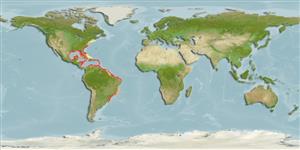
laut dasar (demersal); kisaran kedalaman 40 - 300 m (Ref. 9626), usually 40 - 100 m (Ref. 9626). Subtropical; 42°N - 33°S, 99°W - 30°W (Ref. 55)
Western Atlantic: Bermuda and North Carolina, USA, to São Paulo, Brazil (Ref. 57756), including West Indies, Gulf of Mexico and Caribbean Sea (Anderson, pers. comm.).
Panjang pada saat jatuh tempo pertama / Ukuran / Berat / umur
Kematangan: Lm 18.8, range 15 - 23 cm
Max length : 60.0 cm TL jantan/; (Ref. 26938); common length : 35.0 cm TL jantan/; (Ref. 55); Berat maksimum terpublikasi: 3.2 kg (Ref. 40637); Umur maksimum dilaporkan: 13 Tahun (Ref. 35875)
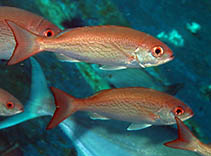
Duri punggung (Keseluruhan (total)) : 12 - 13; duri punggung lunak (Keseluruhan (total)) : 10 - 11; Duri dubur: 3; Sirip dubur lunak: 8. Snout short, lower jaw slightly projecting. Mouth small. Pectoral fins relatively short, not reaching level of anus. Scale rows on back rising obliquely above lateral line. Back and upper sides vermilion, shading to silvery with reddish tinge ventrally, with narrow horizontal yellow lines below the lateral line. The dorsal and caudal fins yellowish; the anal and pelvic fins whitish.
Body shape (shape guide): fusiform / normal; Cross section: oval.
Adults are found in moderately deep waters, most common over rock, gravel or sand bottoms near the edge of the continental and island shelves, often in large schools. Young fish occur in shallower depths (below 25 m), also often forming large schools. They feed on fishes, shrimps, crabs, polychaetes, other benthic invertebrates, cephalopods and planktonic organisms. Good food fish (Ref. 9626).
Spawning occurs over most of the year with peak activity during spring and summer, at least in the northern part of the range (Puerto Rico to the Carolinas).
Allen, G.R., 1985. FAO Species Catalogue. Vol. 6. Snappers of the world. An annotated and illustrated catalogue of lutjanid species known to date. FAO Fish. Synop. 125(6):208 p. Rome: FAO. (Ref. 55)
Status IUCN Red List (Ref. 130435: Version 2025-2 (Global))
ancaman kepada manusia
Harmless
penggunaan manusia
Perikanan: nilai komersial kecil; Ikan buruan: ya
Alat, peralatan
laporan khas
muat turun XML
Sumber internet
Estimasi berdasarkan model
Suhu yang disukai (Acuan
123201): 18.3 - 27.2, mean 23.9 °C (based on 185 cells).
Indeks keanekaragaman filogenetik (Acuan
82804): PD
50 = 1.0000 [Uniqueness, from 0.5 = low to 2.0 = high].
Bayesian length-weight: a=0.01514 (0.01346 - 0.01702), b=2.95 (2.92 - 2.98), in cm total length, based on LWR estimates for this species (Ref.
93245).
Tingkat Trofik (Acuan
69278): 4.4 ±0.2 se; based on diet studies.
Generation time: 12.2 ( na - na) years. Estimated as median ln(3)/K based on 2
growth studies.
Daya lenting (Acuan
120179): Rendah, Waktu penggandaan populasi minimum 4.5 - 14 tahun (K=0.09-0.20; tm=2-4; tmax=13; Fec<10,000).
Prior r = 0.43, 95% CL = 0.28 - 0.64, Based on 3 full stock assessments.
Kerentanan Penangkapan Ikan (Ref.
59153): Moderate to high vulnerability (50 of 100).
🛈
Kerentanan Iklim (Ref.
125649): High to very high vulnerability (74 of 100).
🛈
Nutrisi (Ref.
124155): Calcium = 57.3 [19.9, 118.3] mg/100g; Iron = 0.974 [0.512, 1.815] mg/100g; Protein = 18.9 [17.1, 20.6] %; Omega3 = 0.408 [0.255, 0.664] g/100g; Selenium = 33.1 [17.3, 65.9] μg/100g; VitaminA = 21.1 [6.4, 83.8] μg/100g; Zinc = 0.526 [0.349, 0.788] mg/100g (wet weight);