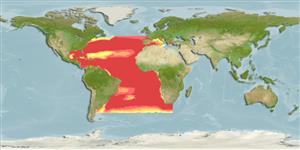
Ambiente: milieu / zona climática / intervalo de profundidade / gama de distribuição
Ecologia
marinhas pelagic-oceanic; oceanódromo (Ref. 71039); intervalo de profundidade 0 - 150 m (Ref. 43), usually 0 - 100 m (Ref. 55219). Subtropical; 22°C - ? (Ref. 12451); 47°N - 45°S, 99°W - 27°E (Ref. 55219)
Atlantic Ocean: roughly from 45°N to 45°S in the southwestern Atlantic and 35°S in the southeastern Atlantic. Records from the Mediterranean Sea, and from Bretagne, France seem to correspond to a few straying individuals. Classified as 'reduced' (Ref. 12451). It is unclear whether there are two separate stocks or a single population in the Atlantic. Highly migratory species.
Comprimento na primeira maturidade / Tamanho / Peso / Idade
Maturidade: Lm 164.0, range 130 - ? cm
Max length : 300 cm TL macho/indeterminado; (Ref. 4770); common length : 210 cm TL macho/indeterminado; (Ref. 5217); peso máx. Publicado: 82.5 kg (Ref. 43)
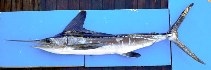
Espinhos dorsais (total) : 0; Raios dorsais moles (total) : 43 - 52; Espinhos anais: 0; Raios anais moles: 17 - 23. Blue-black above, silvery white and splattered with brown on the sides, silvery white below; sometimes with more than 15 rows of obscure whitish stripes; 1st dorsal fin dark blue with black dots; 2nd dorsal fin dark blue; pectorals blackish brown, with tinges of silvery white in some specimens; pelvic fins blue-black with a black fin membrane; caudal fin blackish brown.
Body shape (shape guide): elongated.
Usually above the thermocline. Its distribution varies seasonally, reaching higher latitudes in both the northern and southern hemispheres only during the respective warm seasons. Usually found in deep (over 100 m) blue water with surface temperatures over 22°C and salinities of 35 to 37 ppt. Currents of 0.5 to 2 knots occur over much of its habitat. Feeds on fishes and squids. Females grow larger (Ref. 4770). Flesh is of excellent quality. Marketed fresh and frozen.
Ciclo de vida e comportamento de acasalamento
Maturidade | Reprodução | Desova | Ovos | Fecundidade | Larvas
Migrates into subtropical waters to spawn, with peak spawning occurring in early summer. The spawning areas are found in deep and blue oceanic waters, generally at high temperatures ranging from 20° to 29°C except in the southern Atlantic gyrals, and high surface salinities (over 35 ppt).
Nakamura, I., 1985. FAO species catalogue. Vol. 5. Billfishes of the world. An annotated and illustrated catalogue of marlins, sailfishes, spearfishes and swordfishes known to date. FAO Fish. Synop. 125(5):65p. Rome: FAO. (Ref. 43)
Categoria na Lista Vermelha da IUCN (Ref. 130435: Version 2025-2 (Global))
Ameaça para o homem
Harmless
Utilização humana
Pescarias: pouco comercial; peixe desportivo: sim
Ferramentas
Relatórios especiais
Descarregue XML
Fontes da internet
Estimativas baseadas em modelos
Temperatura preferida (Ref.
123201): 15.7 - 27.9, mean 25.1 °C (based on 1614 cells).
Índice de diversidade filogenética (Ref.
82804): PD
50 = 0.7505 [Uniqueness, from 0.5 = low to 2.0 = high].
Bayesian length-weight: a=0.00447 (0.00195 - 0.01025), b=3.14 (2.94 - 3.34), in cm total length, based on LWR estimates for this (Sub)family-body shape (Ref.
93245).
Nível Trófico (Ref.
69278): 4.5 ±0.4 se; based on diet studies.
Generation time: 1.9 ( na - na) years. Estimated as median ln(3)/K based on 1
growth studies.
Resiliência (Ref.
120179): Médio, tempo mínimo de duplicação da população 1,4 - 4,4 anos (K=0.58; assuming tm >=2).
Prior r = 0.24, 95% CL = 0.16 - 0.36, Based on 1 full stock assessment.
Vulnerabilidade da pesca (Ref.
59153): Moderate vulnerability (41 of 100).
🛈
Vulnerabilidade climática (Ref.
125649): High vulnerability (62 of 100).
🛈
Nutrientes (Ref.
124155): Calcium = 38 [16, 74] mg/100g; Iron = 1.1 [0.6, 2.1] mg/100g; Protein = 19.9 [18.6, 21.1] %; Omega3 = 0.225 [0.114, 0.444] g/100g; Selenium = 46.4 [22.1, 100.3] μg/100g; VitaminA = 4.21 [1.14, 15.31] μg/100g; Zinc = 0.34 [0.22, 0.53] mg/100g (wet weight);