Elasmobranquios (tiburones y rayas) (sharks and rays) >
Rajiformes (Skates and rays) >
Arhynchobatidae (Softnose skates)
Etymology: Bathyraja: Greek, bathys = deep + Latin, raja, -ae = a ray (Raja sp) (Ref. 45335); abyssicola: From the Latin 'abyssos' meaning bottomless and 'cola' meaning living at depths; referring to its deep-sea habitat.
More on author: Gilbert.
Entorno: milieu / zona climática / rango de profundidad / gama de distribución
Ecología
marino batidemersal; rango de profundidad 362 - 2910 m (Ref. 50610). Deep-water
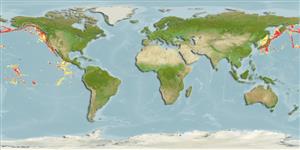
North Pacific: Bering Sea; south to the Galapagos Islands, west to Japan.
Longitud en la primera madurez / Tamaño / Peso / Edad
Madurez: Lm ? range ? - 147 cm
Max length : 135 cm TL macho / no sexado; (Ref. 126515); 157.0 cm TL (female)
Descripción breve
Claves de identificación | Morfología | Morfometría
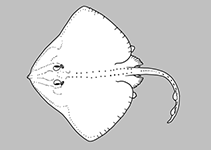
This large, rhomboidal skates (to at least 157 cm TL) have a triangularly shaped disc (width 44.2-63.7% TL), long head length (19.7-27.8% TL), and with rounded pectoral apices; claspers are very long and slender, the tips conspicuously bulbous, large and wide pseudosiphon present, length 20.0% of clasper, with a distinct, curved pseudorhipidion, the inner surface with a defined V-shaped cleft; ventral lobe with a rounded projection; teeth in 27-39 rows on upper jaw, 24-34 rows on lower jaw; pectoral radials 82; pelvic fins 19; total vertebrae 139; the dorsal and ventral surface of disc with prickly dermal denticles and with thorns on dorsal surface of disc, the males with a well-developed alar thorns, no malar thorns, middorsal thorns weak or absent (0-2), the scapulars often none, nuchal thorns strong (2-4), tail thorns moderate (15-30), down the length of tail, interdorsals are weak or obsolete (0-1). Colouration: dorsal dark brown or black-grey, sometimes with small dark blotches scattered on body, the pectoral fin edges are darker than the rest of body, pelvic fins often with whitish anterior tips while ventral is darker than dorsal surface, usually white around the mouth, gills, and cloaca (Ref. 126515).
Cross section: flattened.
This species lives in deep waters, on the upper continental slope and often over fine sediment; reported to have a preference for colder temperatures than its congeners. The size at maturity for males is from 109 to 120 cm TL, for females 145 cm TL; size at birth uncertain, with the smallest free-swimming specimen measured 19 cm TL. Feeds on annelids, cephalopods, crabs, shrimps, and bony fishes, the smaller individuals consume more invertebrates (Ref. 126515). Oviparous. Distinct pairing with embrace. Young may tend to follow large objects, such as their mother (Ref. 205). Eggs are oblong capsules with stiff pointed horns at the corners deposited in sandy or muddy flats (Ref. 205). The light golden brown egg cases are large (10.8-11.1 cm TL), with coarse surface due to the rasp-like denticles; with a distinct groove between the lateral keel and the case (absent in all other ENP skate egg cases) and with horns at the corners, the anterior horns more robust than posteriors, with both sets becoming flat and thread-like at tips (Ref. 126515).
Ciclo vital y comportamiento de apareamiento
Madurez | Reproducción | Puesta | Huevos | Fecundidad | Larva
Oviparous, paired eggs are laid. Embryos feed solely on yolk (Ref. 50449). Distinct pairing with embrace. Young may tend to follow large objects, such as their mother (Ref. 205).
Knuckey, J.D.S. and D.A. Ebert, 2022. A taxonomic revision of Northeast Pacific softnose skates (Rajiformes: Arhynchobatidae: Bathyraja Ishiyama). Zootaxa 5142(1):1-89. (Ref. 126515)
Situación en la Lista Roja de la UICN (Ref. 130435: Version 2025-2 (Global))
Amenaza para el ser humano
Harmless
Usos humanos
Herramientas
Informes especiales
Descargar XML
Fuentes de Internet
Estimaciones basadas en modelos
Temperatura preferida (Referencia
123201): 2.3 - 4.6, mean 2.8 °C (based on 206 cells).
Índice de diversidad filogenética (Referencia
82804): PD
50 = 0.5000 [Uniqueness, from 0.5 = low to 2.0 = high].
Bayesian length-weight: a=0.00562 (0.00296 - 0.01067), b=3.13 (2.97 - 3.29), in cm total length, based on LWR estimates for this Genus-body shape (Ref.
93245).
Nivel trófico (Referencia
69278): 4.1 ±0.7 se; based on size and trophs of closest relatives
Resiliencia (Referencia
120179): Bajo, población duplicada en un tiempo mínimo de 4.5-14 años (Fec assumed to be <100).
Vulnerabilidad pesquera (Ref.
59153): Very high vulnerability (90 of 100).
🛈