Elasmobranchii (tubarões e raias) (sharks and rays) >
Rajiformes (Skates and rays) >
Arhynchobatidae (Softnose skates)
Etymology: Bathyraja: Greek, bathys = deep + Latin, raja, -ae = a ray (Raja sp) (Ref. 45335); lindbergi: Named for Dr. G. U. Lindberg, for his work on western North Pacific zoogeography (Ref. 75535).
Eponymy: Dr Georgii Ustinovich Lindberg (1894–1976) was a Russian ichthyologist and marine biologist who was a lecturer at Chita University and who was invited (1923) to the Far-Eastern University in Vladivostok where he established a coastal biological [...] (Ref. 128868), visit book page.
Meio ambiente: milieu / Zona climática / intervalo de profundidade / faixa de distribuição
Ecologia
marinhas demersal; intervalo de profundidade ? - 2000 m (Ref. 96339), usually 200 - ? m (Ref. 43939). Temperate
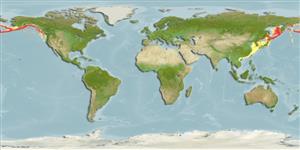
North Pacific: Sea of Okhotsk off Hokkaido, Japan to the Bering Sea.
Tamanho / Peso / Idade
Maturidade: Lm ? range ? - ? cm
Max length : 60.7 cm WD macho/indeterminado; (Ref. 75535); 53.2 cm WD (female)
Descrição suscinta
Chaves de identificação | Morfologia | Morfometria
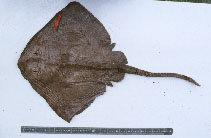
Vértebras: 113 - 117. This species is distinguished from its congeners Bathyraja in having a whitish brown coloration on the ventral surface of the disk, contrasting the dark greyish brown on other parts; scapular spine absent; row of middorsal spines uninterrupted, running from before scapular arch to first dorsal (Ref. 75535).
Body shape (shape guide): other.
Oviparous (Ref. 50449). Eggs have horn-like projections on the shell (Ref. 205). Depth range given by H. Ishihara (pers.comm. 07/07).
Ciclo de vida ou comportamento de acasalamento
Maturidade | Reprodução | Desova | Ovos | Fecundidade | Larvas
Oviparous, paired eggs are laid. Embryos feed solely on yolk (Ref. 50449). Eggs have horn-like projections on the shell (Ref. 205).
McEachran, J.D. and K.A. Dunn, 1998. Phylogenetic analysis of skates, a morphologically conservative clade of elasmobranchs (Chondrichthyes: Rajidae). Copeia 1998(2):271-290. (Ref. 27314)
Status na Lista Vermelha da UICN (Ref. 130435: Version 2025-2 (Global))
Ameaça para os humanos
Harmless
Uso pelos humanos
Ferramentas
Relatórios especiais
Baixar XML
Fontes da internet
Estimativas baseadas em modelos
Temperatura preferida (Ref.
123201): 1.3 - 4.2, mean 2.6 °C (based on 235 cells).
Índice de diversidade filogenética (Ref.
82804): PD
50 = 0.5000 [Uniqueness, from 0.5 = low to 2.0 = high].
Bayesian length-weight: a=0.00562 (0.00296 - 0.01067), b=3.13 (2.97 - 3.29), in cm total length, based on LWR estimates for this Genus-body shape (Ref.
93245).
Nível Trófico (Ref.
69278): 4.0 ±0.7 se; based on size and trophs of closest relatives
Resiliência (Ref.
120179): Baixo, tempo mínimo de duplicação da população 4,5 - 14 anos (Fec assumed to be <100).
Vulnerabilidade da pesca (Ref.
59153): High vulnerability (62 of 100).
🛈