>
Anguilliformes (Eels and morays) >
Synaphobranchidae (Cutthroat eels) > Synaphobranchinae
Etymology: Synaphobranchus: Greek, syn, symphysis = grown together + Greek, aphoo, aphiemi = to throw + Greek, brangchia = gill (Ref. 45335).
More on author: Günther.
Umwelt: Milieu / Klimazone / Tiefenbereich / Verbreitungsgebiet
Ökologie
seewasser benthopelagisch; tiefenbereich 230 - 3000 m (Ref. 26895), usually 1000 - 2500 m (Ref. 58302). Deep-water; 2°C - 11°C (Ref. 26895); 37°N - 29°S
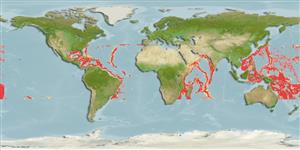
Circumtropical, except the northeast Pacific (Ref. 26895). Indo-Pacific: Zanzibar and Maldives, Japan and Australia (Ref. 7300). Western Central Atlantic: Gulf of Mexico and off Suriname (Ref. 13608).
Größe / Gewicht / Alter
Geschlechtsreife: Lm ? range ? - ? cm
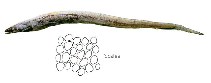
Max length : 111 cm TL Männchen/unbestimmt; (Ref. 26895)
Kurzbeschreibung
Bestimmungsschlüssel | Morphologie | Morphometrie
A benthic species (Ref. 75154) found on the continental slope (Ref. 7300, 75154). Minimum depth reported taken from Ref. 86942.
Lebenszyklus und Paarungsverhalten
Geschlechtsreife | Fortpflanzung | Ablaichen | Eier | Fruchtbarkeit | Larven
Sulak, K.J. and Y.N. Shcherbachev, 1997. Zoogeography and systematics of six deep-living genera of synaphobranchid eels, with a key to taxa and description of two new species of Ilyophis. Bull. Mar. Sci. 60(3):1158-1194. (Ref. 26895)
IUCN Rote Liste Status (Ref. 130435: Version 2025-2 (Global))
Bedrohung für Menschen
Harmless
Nutzung durch Menschen
Tools
Zusatzinformationen
Download XML
Internet Quellen
Schätzungen auf der Grundlage von Modellen
Bevorzugte Temperatur (Ref.
123201): 1.9 - 4.7, mean 2.8 °C (based on 3258 cells).
Phylogenetischer Diversitätsindex (Ref.
82804): PD
50 = 0.5156 [Uniqueness, from 0.5 = low to 2.0 = high].
Bayesian length-weight: a=0.00072 (0.00031 - 0.00170), b=3.12 (2.92 - 3.32), in cm total length, based on LWR estimates for this (Sub)family-body shape (Ref.
93245).
Trophische Ebene (Ref.
69278): 4.3 ±0.5 se; based on size and trophs of closest relatives
Widerstandsfähigkeit (Ref.
120179): mittel, Verdopplung der Population dauert 1,4 - 4,4 Jahre. (Assuming fecundity > 100).
Anfälligkeit der Fischerei (Ref.
59153): High to very high vulnerability (67 of 100).
🛈