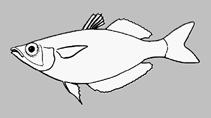
Cairnsichthys rhombosomoides, Cairns rainbowfish

You can sponsor this page

Cairnsichthys rhombosomoides (Nichols & Raven, 1928)

Cairns rainbowfish
Envoyez vos Photos et vidéos
Images Google
Image of Cairnsichthys rhombosomoides (Cairns rainbowfish)
No image available for this species;
drawing shows typical species in Melanotaeniidae.

Classification / Noms Noms communs | Synonymes | Catalog of Fishes(Genre, Espèce) | ITIS | CoL | WoRMS | Cloffa

> Atheriniformes (Silversides) > Melanotaeniidae (Rainbowfishes, blue eyes)
Etymology: Cairnsichthys: Named after the north Queensland town of Cairns + Greek, ichthys = fish; Collected in 1921, in Babinda Creek; personal communication from Mister Kuiter. See Kuiterichthys.
More on authors: Nichols & Raven.

Environnement : milieu / zone climatique / profondeur / gamme de distribution Écologie

; eau douce démersal; pH range: 7.2 - 7.6; dH range: 10 - ?. Tropical; 21°C - 25°C (Ref. 2060)

Distribution Territoires | Zones FAO | Écosystèmes | Occurrences | Carte par point | Introductions | Faunafri

Oceania: endemic to Australia.

Taille / Poids / Âge

Maturité: Lm ?  range ? - ? cm
Max length : 8.5 cm SL mâle / non sexé; (Ref. 44894); 6.5 cm SL (female); common length : 6.0 cm SL mâle / non sexé; (Ref. 44894)

Biologie     Glossaire (ex. epibenthic)

Occurs in small rainforest creeks usually in hilly terrain with alternating sections of rapids and rocky pools varying in depth from several centimeters to one to three meters. Bottom composed of boulders, cobbles and gravel with minimal plant growth. In spite of the limited distribution its future seems secure as long as the rainforest habitat of the Bellenden Ker Range is protected. Much of this area lies within a national park (Ref. 44894).

Cycle de vie et comportement reproducteur Maturité | Reproduction | Frai | Œufs | Fécondité | Larves

Référence principale Téléchargez vos références | Références | Coordinateur | Collaborateurs

Allen, G.R., 1989. Freshwater fishes of Australia. T.F.H. Publications, Inc., Neptune City, New Jersey. (Ref. 5259)

Statut dans la liste rouge de l'IUCN (Ref. 130435: Version 2025-2 (Global))

  Menacé (EN) (B1ab(i,ii,iii)+2ab(i,ii,iii)); Date assessed: 15 February 2019

CITES

Not Evaluated

CMS (Ref. 116361)

Not Evaluated

Menace pour l'homme

  Harmless


Utilisations par l'homme

FAO - Publication: search | FishSource |

Plus d'informations

Écologie trophique
Aliments (proies)
Composition du régime alimentaire
Consommation alimentaire
Rations alimentaires
Prédateurs
Écologie
Écologie
Dynamique des populations
Paramètres de croissance
Âges / tailles maximales
Longueur-poids rel.
Rel. longueur-longueur.
Fréquences de longueurs
Conversion de masse
Recrutement
Abondance
Cycle de vie
Reproduction
Maturité
Maturité/épines rel.
Fécondité
Frai
Agrégats de frai
Œufs
Développement de l'œuf
Larves
Dynamique des populations larvaires
Distribution
Territoires
Zones FAO
Écosystèmes
Occurrences
Introductions
BRUVS - Vidéos
Anatomie
Surface branchiale
Cerveau
Otolithe
Physiologie
Composition corporelle
Nutriments
Consommation d'oxygène
Type de natation
Vitesse de nage
Pigments visuels
Son de poisson
Maladies et parasites
Toxicité (CL50)
Génétique
génôme
Génétique
Hétérozygotie
Héritabilité
Diversité génétique
Liées à l'homme
Systèmes d'aquaculture
Profils d'aquaculture
Souches
Cas de ciguatera
Timbres, pièces de monnaie, divers
Sensibilisation
Collaborateurs
Taxonomie
Noms communs
Synonymes
Morphologie
Morphométrie
Images
Références
Références

Outils

Articles particuliers

Télécharger en XML

Sources Internet

AFORO (otoliths) | Aquatic Commons | BHL | Cloffa | Websites from users | FishWatcher | CISTI | Catalog of Fishes: Genre, Espèce | DiscoverLife | ECOTOX | FAO - Publication: search | Faunafri | Fishipedia | Fishtrace | GloBI | Google Books | Google Scholar | Google | IGFA World Record | OneZoom | Open Tree of Life | Otolith Atlas of Taiwan Fishes | PubMed | Reef Life Survey | Socotra Atlas | TreeBase | Arbre de Vie | Wikipedia: aller à, chercher | World Records Freshwater Fishing | Zoological Record

Estimations basées sur des modèles

Indice de diversité phylogénétique (Réf. 82804):  PD50 = 0.7500   [Uniqueness, from 0.5 = low to 2.0 = high].
Bayesian length-weight: a=0.00389 (0.00180 - 0.00842), b=3.12 (2.94 - 3.30), in cm total length, based on all LWR estimates for this body shape (Ref. 93245).
Niveau trophique (Réf. 69278):  2.9   ±0.41 se; based on food items.
Résilience (Réf. 120179):  Milieu, temps minimum de doublement de population : 1,4 à 4,4 années (Fec = 131).
Vulnérabilité de la pêche (Ref. 59153):  Low vulnerability (10 of 100). 🛈